



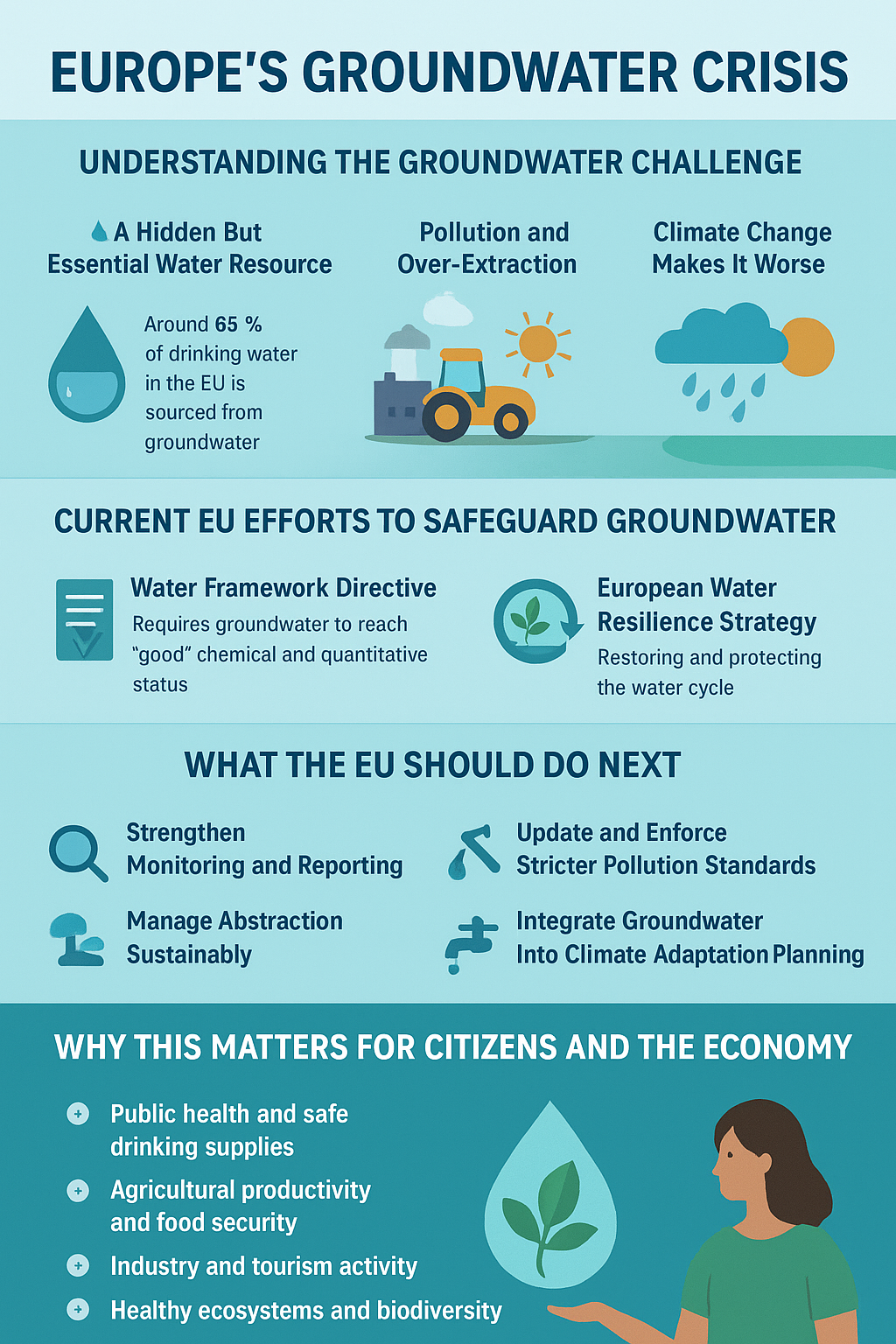

Groundwater — the freshwater stored beneath our feet in soil and rock formations — is one of Europe’s most vital natural resources. It supplies a large share of drinking water, supports agriculture and industry, and maintains the health of rivers, wetlands and ecosystems. Yet in recent years, scientists, environmental analysts and government reports have raised alarms: Europe’s groundwater is under increasing stress from pollution, over-abstraction and climate change, threatening long-term water security across the continent. European Environment Agency
Understanding the Groundwater Challenge
1. A Hidden but Essential Water Resource
Groundwater is not visible like rivers and lakes, but it plays a central role in Europe’s water cycle and human water use. Across the European Union:
- Around 65 % of drinking water comes from groundwater sources.
- Groundwater also supplies 25 % of agricultural irrigation.
- There are more than 12,000 distinct groundwater bodies across the EU. European Environment Agency
Because it is tucked below the surface, groundwater moves slowly, and pollution or depletion can take years or even decades to reverse. This makes sustainable management especially important. Environment
2. Pollution and Over-Extraction
Two intertwined pressures are undermining groundwater in Europe:
Pollution
Fertilisers, pesticides, industrial chemicals and other contaminants increasingly seep into aquifers. Once polluted, groundwater is difficult and expensive to clean up. Even low levels of nitrates or certain chemicals can render water unsafe. European Environment Agency
The presence of “forever chemicals” and pharmaceuticals has also become a growing concern, with EU policymakers working to expand the list of monitored pollutants and enforce stricter standards. Consilium
Over-Abstraction
In many regions — especially in southern Europe — farmers and communities rely heavily on groundwater for irrigation and drinking water. When withdrawals exceed natural recharge, water tables fall and aquifers lose storage capacity. European Environment Agency
3. Climate Change Makes It Worse
Climate change intensifies droughts, alters rainfall patterns and increases evaporation. These changes reduce natural recharge — the process by which rainwater seeps down to replenish aquifers. In many parts of Europe, heavy downpours cause rapid surface runoff rather than slow absorption into the ground, meaning aquifers don’t refill as they once did. Under the Surface
Current EU Efforts to Safeguard Groundwater
The European Union already has several legal and policy frameworks aimed at protecting water:
Water Framework Directive
This foundational law requires all groundwater bodies to reach “good” chemical and quantitative status, meaning they are both clean and abundant enough for sustainable use. Progress has been made, but a significant share of groundwater is still below desired standards. Environment
Recently, the EU Council agreed a mandate to update the list of monitored water pollutants — including expanding standards for synthetic chemicals and certain PFAS substances — to strengthen protection for groundwater and surface water alike. Consilium
European Water Resilience Strategy
Part of the wider European Green Deal, the forthcoming Water Resilience Strategy aims to restore and protect Europe’s water cycle. It will build on existing directives, improve water management and enhance climate adaptation measures. Environment
What the EU Should Do Next
Despite existing initiatives, groundwater remains vulnerable. Here are key actions the EU should prioritise to ensure water security for future generations:
1. Strengthen Monitoring and Reporting
Many countries have incomplete or inconsistent groundwater data reporting. The EU must ensure full, standardised monitoring of both quantity and quality, including emerging contaminants such as microplastics and pharmaceutical residues. Under the Surface
2. Update and Enforce Stricter Pollution Standards
EU policy must move beyond minimum compliance and adopt more ambitious quality thresholds for chemicals that pose serious risks to human health and ecosystems. This includes accelerating the revision of groundwater pollutant lists and tightening limits on agrichemicals and industrial contaminants. Consilium
3. Manage Abstraction Sustainably
Groundwater withdrawals must be balanced with natural recharge rates. Member states should adopt science-based abstraction limits, especially in drought-prone regions, and promote water-saving technologies in agriculture and industry.
4. Integrate Groundwater into Climate Adaptation Planning
Climate change is not a future threat — it is already impacting rainfall patterns and drought frequency. The EU should integrate groundwater resilience into its climate adaptation strategies, encouraging nature-based solutions such as wetlands restoration and soil measures that improve infiltration. Environment
5. Support Local and Basin-Level Governance
Effective groundwater stewardship is not just about top-down rules. Local communities, farmers, water utilities and stakeholders must be involved in designing and testing solutions that fit local hydrogeological realities. “Living lab” approaches, where users help shape and trial programmes, have shown promise in strengthening water governance. Environment
Why This Matters for Citizens and the Economy
Clean and abundant groundwater is about more than tap water — it underpins:
- Public health and safe drinking supplies
- Agricultural productivity and food security
- Industry and tourism activity
- Healthy ecosystems and biodiversity
Failing to act risks escalating water scarcity, higher treatment costs, compromised food production and environmental degradation. A comprehensive and enforceable groundwater strategy is therefore essential for Europe’s long-term wellbeing.
Conclusion
Europe’s groundwater crisis is real, multifaceted and intensifying. While the EU has made strides in protecting water resources, the current evidence shows the need for faster, stronger and more coordinated action across all member states. This includes better data collection, stricter pollution controls, sustainable water use limits, climate adaptation integration and stronger governance — all essential steps toward a resilient and secure European water future.

