




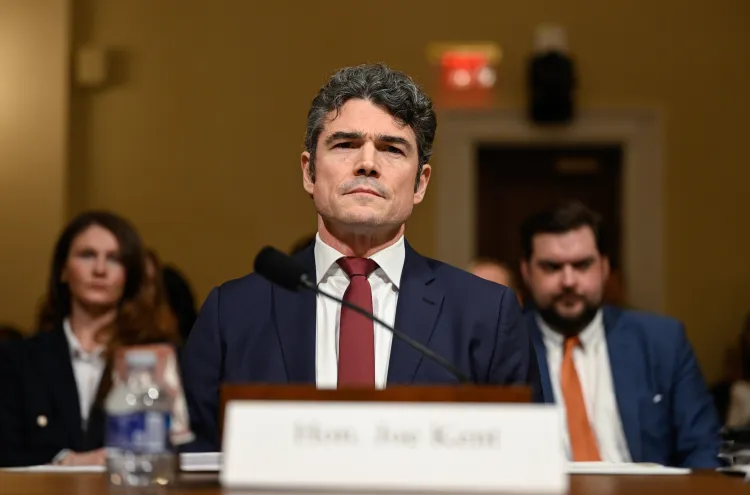
Joe Kent, decorated Special Forces veteran and longtime Trump loyalist, breaks ranks to warn president was deceived by foreign influence
By WestFerryTimes Staff
March 17, 2026 | Updated 9:07 PM GMT
WASHINGTON — In the most significant internal defection of the Trump administration’s second term, National Counterterrorism Center Director Joe Kent has resigned in protest over the U.S. war in Iran, posting a blistering letter that accuses the president of being manipulated into military action by Israeli officials and their American allies.
Kent, a 45-year-old former Army Green Beret and CIA paramilitary officer with eleven combat deployments, declared that Iran posed “no imminent threat” to the United States and alleged the administration “started this war due to pressure from Israel and its powerful American lobby.”
The resignation marks the first time a senior intelligence official with direct access to classified threat assessments has publicly challenged the administration’s justification for the conflict, which began [date of conflict start].
‘Echo Chamber of Misinformation’
In a letter posted to his X account Tuesday, Kent addressed Trump directly with extraordinary candor for a former administration official. He claimed that “high-ranking Israeli officials” and “influential US journalists” had constructed an “echo chamber” that deceived the president into abandoning his “America First” platform.
“This echo chamber was used to deceive you into believing that Iran posed an imminent threat to the United States,” Kent wrote. “This was a lie.”
The allegations strike at the heart of the administration’s legal and political justification for military action. Trump and senior officials have maintained that Iran was preparing an imminent attack on U.S. interests, though they have not publicly disclosed the specific intelligence underlying that assessment.
Kent’s position as director of the National Counterterrorism Center gave him access to the government’s most sensitive intelligence on terrorist threats worldwide. He reported to Director of National Intelligence Tulsi Gabbard.
From Trump Loyalist to Whistleblower
Kent’s defection carries additional weight given his history as a committed Trump supporter. A two-time congressional candidate in Washington state, Kent gained national attention during his 2022 and 2024 campaigns for his staunch alignment with the MAGA movement and his promotion of conspiracy theories regarding the January 6, 2021 Capitol riot and the 2020 presidential election.
During his contentious Senate confirmation hearing earlier this year, Kent refused to disavow claims that federal agents had instigated the January 6 violence or that Trump had actually won the 2020 election. His narrow confirmation faced unified Democratic opposition and criticism over his associations with extremist groups, including members of the Proud Boys.
His transformation from administration loyalist to public critic suggests that internal dissent over the Iran conflict extends beyond traditional foreign policy establishment circles and into the president’s own political base.
Personal Stakes
Kent’s opposition to the war appears deeply rooted in personal experience. His wife, Navy Senior Chief Cryptologic Technician Shannon Kent, was killed in a suicide bombing in Manbij, Syria, in January 2019 while supporting counter-ISIS operations. The attack, which claimed the lives of four Americans, occurred during Trump’s first term.
Joe Kent left government service following her death to raise their two sons before returning to public life as a political candidate and, ultimately, administration official.
In his resignation letter, he invoked both his military service and his wife’s sacrifice to explain his decision.
“I cannot support sending the next generation off to fight and die in a war that serves no benefit to the American people nor justifies the cost of American lives,” he wrote.
White House Denounces ‘Insulting’ Claims
The administration moved swiftly to discredit its former counterterrorism chief. Speaking in the Oval Office Tuesday afternoon, Trump characterized Kent as well-intentioned but fundamentally unsuited for national security leadership.
“I thought he was a nice guy, but weak on security,” Trump told reporters. “When I read that letter, I realized it was a good thing that he’s out.”
The president reiterated his claim that “strong and compelling evidence” supported the decision to strike Iran first, though he provided no additional details.
White House Press Secretary Karoline Leavitt was more forceful in her rebuttal, calling Kent’s suggestion that foreign influence shaped the president’s decision “both insulting and laughable.”
“As President Trump has clearly and explicitly stated, he had strong and compelling evidence that Iran was going to attack the United States first,” Leavitt said. “The president does not make decisions based on pressure from anyone.”
Conservative Media Divided
Kent’s resignation has exposed fault lines within conservative media and the broader Republican coalition. Tucker Carlson, the former Fox News host and prominent anti-war voice on the right, praised Kent in an interview with The New York Times, calling him “the bravest man I know.”
Carlson, who maintains close personal ties to Kent, warned that “the neocons will try to destroy him” for speaking out. His defense signals that Kent may find refuge in the growing conservative skepticism of foreign military intervention, even as he faces backlash from administration supporters.
Other pro-Trump media figures have begun questioning Kent’s motives and credibility, reviving criticism of his past associations and conspiracy theory promotion during his confirmation process.
Pattern of Departures
Kent’s exit follows several high-profile resignations from senior positions in the second Trump administration, including Securities and Exchange Commission enforcement director Margaret Ryan and Kennedy Center president Ric Grenell. However, none have carried the political or intelligence community significance of the counterterrorism director’s departure.
Despite these exits, turnover in Trump’s current administration remains significantly lower than during his first term, when cabinet members and senior aides frequently departed amid chaos and public disputes.
Kent’s resignation differs qualitatively from previous departures. Where others left over policy disagreements or personal conflicts, Kent has accused the administration of fundamentally deceiving the American public about the justification for military action — a charge that echoes the intelligence controversies preceding the 2003 Iraq War.
Unanswered Questions
Kent’s allegations raise critical questions that the administration has yet to address directly:
- What specific intelligence supported the “imminent threat” assessment regarding Iran?
- Why has this intelligence not been shared with Congress or the public?
- What was the nature of coordination with Israeli officials prior to military action?
- Did political or lobbying pressure influence the decision for war?
Congressional Democrats have begun demanding closed-door briefings on the intelligence underlying the Iran strikes, though Republican majorities in both chambers have limited prospects for formal oversight.
Intelligence community veterans expressed alarm at Kent’s characterization of the threat assessment process.
“When the director of the National Counterterrorism Center says there was no imminent threat, and he had access to everything, you have to take that seriously,” said one former senior intelligence official, speaking on condition of anonymity to discuss sensitive matters. “This isn’t some career bureaucrat with an axe to grind. This is someone who bled for this country and believed in this president.”
What Comes Next
Kent has not indicated whether he will testify before Congress or cooperate with any official inquiries into the administration’s pre-war intelligence. His resignation letter stops short of claiming illegal conduct, focusing instead on what he characterizes as deception and poor judgment.
Legal experts note that as a senior intelligence official, Kent remains subject to classification restrictions that could limit his ability to elaborate on his accusations publicly.
For the administration, the challenge now is containing the fallout from a whistleblower who defies easy political categorization — too decorated to dismiss as unpatriotic, too loyalist to dismiss as a deep-state opponent, and too senior to dismiss as uninformed.
Trump’s response Tuesday suggested a strategy of personal diminishment rather than substantive rebuttal. Whether that approach satisfies a public increasingly wary of foreign military commitments remains to be seen.
As the conflict in Iran enters its [duration], with [casualty figures if available], Kent’s warning that American lives are being spent “for no benefit to the American people” may resonate beyond the immediate news cycle — particularly if the promised evidence of an imminent Iranian attack fails to materialize.

