



By Westferry Times Editorial Team
Recent economic discussions across social media—including widely circulated video explainers—have highlighted a notable shift in global economic rankings: India has slipped behind the United Kingdom in nominal GDP terms. While such content often frames the development as a “decline,” a closer look at official data suggests a more nuanced reality.
What the video explains
The video (circulating on platforms such as Facebook Reels) broadly argues that:
- India’s GDP has fallen behind the UK again
- The change is linked to currency depreciation and global comparisons
- Despite strong growth, India appears to be “losing ground”
These claims are broadly consistent with recent economic reporting, though they require important context.
The data behind the headlines
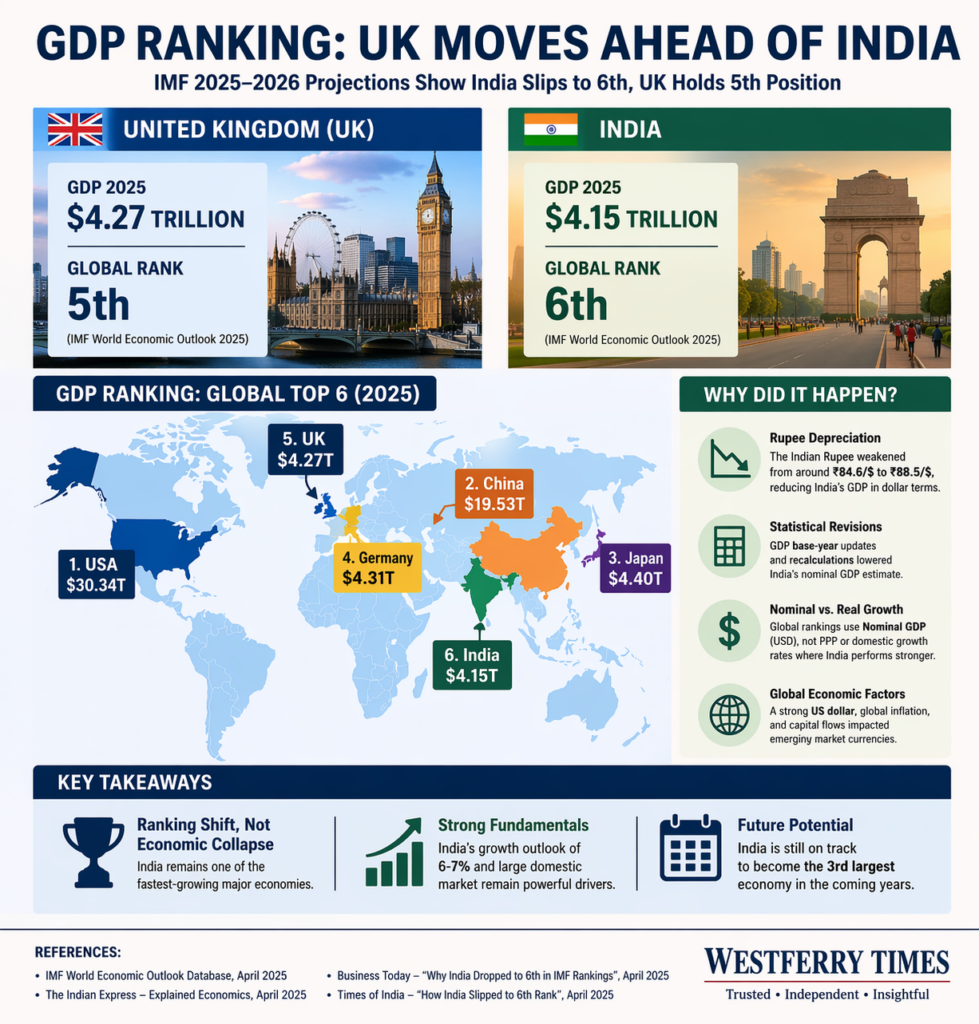
According to the International Monetary Fund (IMF) projections for 2025–2026:
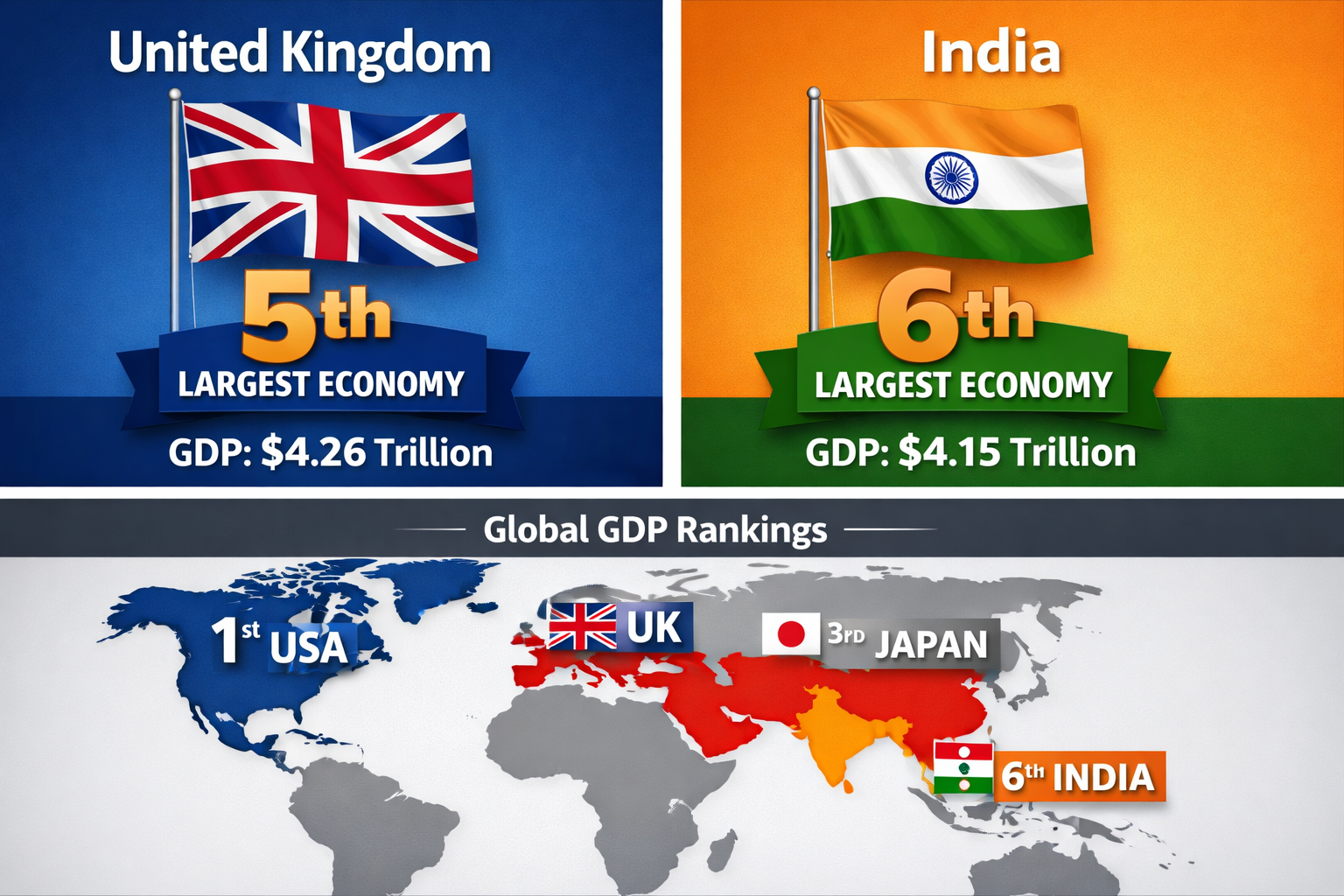
- India’s GDP: around $4.15 trillion
- UK’s GDP: around $4.26–$4.27 trillion
This places India 6th globally, behind the UK and Japan.
However, this shift is not due to a collapse in India’s economy. In fact, India remains one of the fastest-growing major economies, with strong domestic expansion.
Why India’s GDP ranking dropped
1. Rupee depreciation
The most significant factor is the weakening of the Indian rupee:
- Rupee fell from about ₹84.6/$ to ₹88.5/$
- GDP is measured globally in US dollars
This means that even if India grows domestically, its GDP appears smaller in dollar terms.
👉 In simple terms:
Growth in rupees ≠ growth in global rankings.
2. Statistical revisions
Recent GDP base-year revisions and recalculations also reduced India’s nominal GDP estimates.
This is a technical adjustment rather than a real-time economic decline.
3. Exchange rate vs real growth
Global rankings use nominal GDP (USD-based), not:
- Purchasing Power Parity (PPP)
- Domestic growth rates
India performs much better under PPP metrics, where it remains among the top economies globally.
4. Global economic conditions
External pressures also played a role:
- Strong US dollar attracting global capital
- Global inflation and geopolitical tensions
- Capital outflows from emerging markets
These factors weakened currencies like the rupee and impacted rankings.
Why the UK moved ahead
The UK’s position is not necessarily due to rapid growth either. Instead:
- Its currency remained relatively stronger
- Its GDP in dollar terms stayed above India’s
- IMF projections show steady nominal expansion
At the same time, the UK faces its own challenges, including inflation and slower growth trends.
Is this a real economic decline?
Short answer: No.
India’s fall in ranking is largely:
- Currency-driven
- Statistical
- Temporary in nature
Economic fundamentals remain strong:
- Growth projections around 6–7%
- Expanding infrastructure and investment
- Large domestic consumption base
Experts note that the shift is more about measurement methods than economic weakness.
Long-term outlook
Despite the setback:
- India is still projected to become the 3rd largest economy in the coming years
- Structural growth drivers remain intact
However, risks remain:
- Currency volatility
- Global economic shocks
- Domestic policy execution
Conclusion
The viral video narrative of India’s GDP “falling behind” the UK captures only part of the story. While the ranking shift is real, it does not reflect a fundamental decline in India’s economy. Instead, it highlights how exchange rates and statistical adjustments can reshape global comparisons.
For policymakers and analysts, the key takeaway is clear:
economic strength must be judged beyond headline rankings.
References
- IMF World Economic Outlook (2026 projections)
- Business Today analysis on GDP ranking shift
- Eastern Eye economic comparison report
- News reports on rupee depreciation and GDP revisions