




By Political Editor | Westferry Times PUBLISHED: Monday, May 4, 2026
As the United Kingdom prepares for high-stakes local elections this Thursday, May 7th, 2026, nowhere is the tension more palpable than in Cambridgeshire. Combining the world’s second most famous university city, a global visitor hotspot, and the explosive “Silicon Fen” technology hub, this region has become a defining battlefield for five distinct political ideologies. The outcome will decide the future of the UK’s premier innovation engine.
The UK media consensus: A ‘Political Realignment’
The final week of campaigning has seen local media in Cambridge grappling with an unprecedented realignment:
- The Cambridge Independent is predicting “No Overall Control” for the City Council. They highlight Labour’s struggle to retain the young, professional electorate, who are being aggressively courted by the Greens on environmental issues and Reform UK on anti-congestion policies.
- The Cambridge News is running extensive features on the “Early Voting Trials.” For the first time, three “Super Hubs” (The Guildhall, Meadows, and Clay Farm) opened on April 30th to accommodate the busy, highly mobile “Silicon Fen” workforce.
Which party is best for business and entrepreneurs?
Cambridge’s unique status requires a delicate balance of “kindness” and competitiveness. For the entrepreneurial class, the choices are stark:
| Party | Why they are attractive to Business | The local “Friction” point |
|---|---|---|
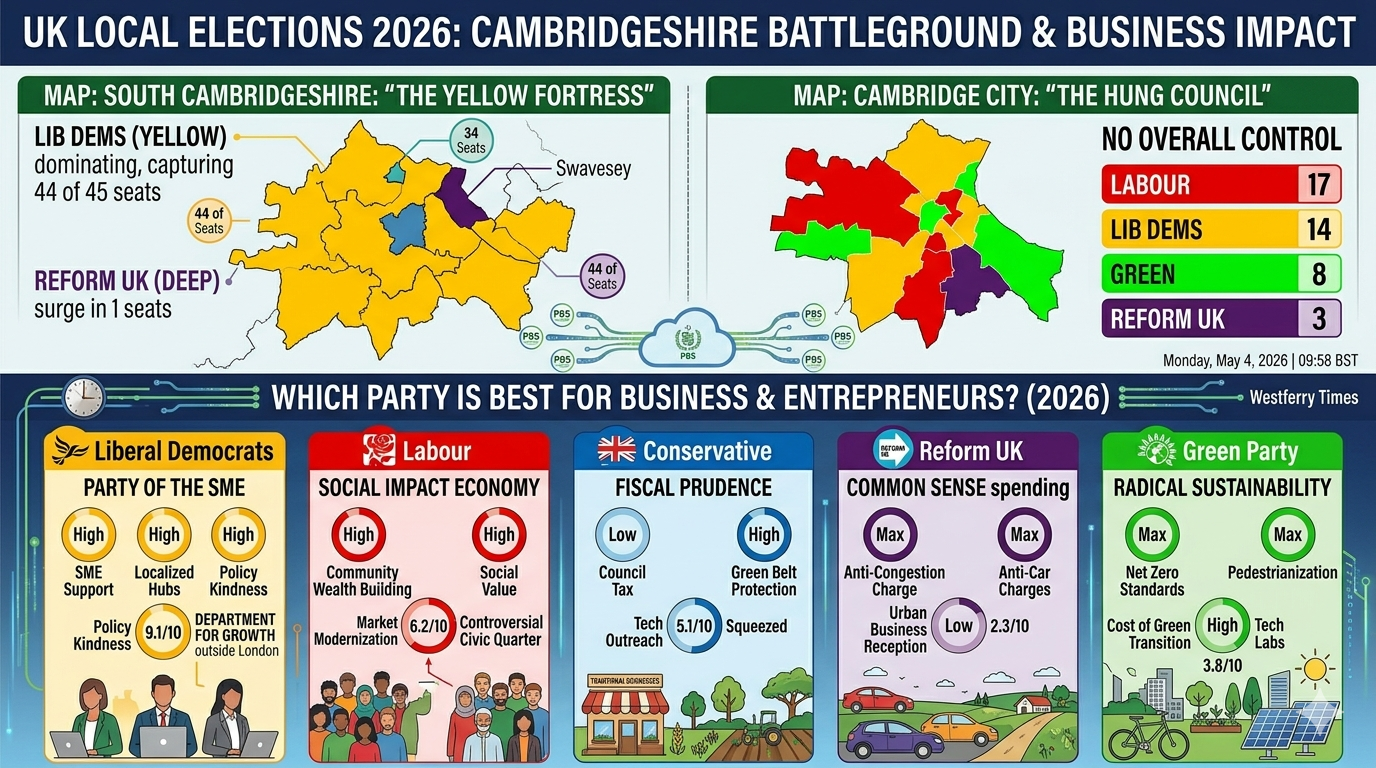
| Liberal Democrats | Party of the SME. Proposing localised enterprise grants (£110k scheme success) and a dedicated “Department for Growth” based outside London. They are viewed as the most “stable and kind” partner. | Critics argue their support in South Cambs is “too comfortable,” leading to slow decision-making on major infrastructure. |
| Labour | Social Impact Leaders. Their “Community Wealth Building” model requires “big tech” firms to provide “social value,” funding local infrastructure like community centers and affordable housing. | The controversial “Civic Quarter” marketplace project has deeply divided business owners over its modernisation plans. |
| Conservative | Fiscal Prudence. The traditional go-to for low council tax and protecting the crucial rural “Green Belt” from over-development. | Squeezed by Reform UK; increasingly perceived as losing touch with the highly diverse, globalised tech workforce. |
| Reform UK | Unapologetically Pro-Car. Gaining significant traction in rural Cambridgeshire by opposing all busway expansions and anti-congestion pricing. | Their anti-congestion rhetoric is perceived as too polarising for the diverse, international core of Cambridge City. |
| Green Party | Radical Sustainability. Demanding the absolute highest “Net Zero” building standards for new laboratory builds and 100% pedestrian zones in the historic core. | Major businesses are concerned about escalating costs for the “Green Transition” and constraints on physical delivery access. |
The “Westferry Times” Predictions
Based on polling data available as of Monday, May 4th, 2026, and an analysis of local economic issues:
1. South Cambridgeshire: “The Yellow Fortress”
- Prediction: Liberal Democrat Hold (Increased Majority).
- The Westferry Times projects the Lib Dems are set to take an astonishing 44 out of 45 seats. Despite a noticeable shift towards Reform UK in more traditional northern wards like Swavesey, the “Kind Young Capitalists” running the tech firms view the Liberal Democrats as the most supportive and predictable environment for sustainable business growth.
2. Cambridge City: “The Hung Council”
- Prediction: No Overall Control.
- Labour is expected to lose its slim overall majority, dropping to approximately 17 seats. The Greens are surging (projected 8 seats), alongside the Lib Dems (projected 14 seats), and Reform UK picking up outliers.
3. The Final Take for Business:
Thursday is unlikely to deliver a mandate for radical change. Instead, Cambridge is set for a “Consultative Coalition.” For businesses and entrepreneurs, this is perhaps the best outcome: it forces a return to traditional local “kindness,” requiring all parties to listen and bring forward resolutions that have genuine, broad-based community support.
Visualising the five-way race
Infographic 1: The Local Issues Compass
This infographic visualises the two biggest local issues dividing Cambridge: Business Growth vs. Environmental Preservation. It shows the five parties mapped against these priorities, illustrating why coalitions are inevitable.

