




India is a land of unparalleled cultural richness, a mosaic formed by thousands of years of migration, assimilation, and coexistence. Key to this diversity are its hundreds of distinct tribal communities and languages. To understand the scale of this, the Government of India conducts a massive decennial exercise known as the Census, managed by the Office of the Registrar General & Census Commissioner, India (ORGI), under the Ministry of Home Affairs. This census remains the definitive source for data on the ethnic and linguistic identities of India’s population.
India is home to over 700 recognised tribal groups, legally designated as ‘Scheduled Tribes’ (STs) in the Fifth Schedule of the Indian Constitution. As of the 2011 Census, Scheduled Tribes comprised approximately 8.6% of India’s total population, totaling over 104 million people.
These communities, often referred to as Adivasis (original inhabitants), possess unique cultures, languages, and traditional ways of life. Their distribution is highly varied across India:
- Central India: This is the heartland of India’s tribal population. States like Madhya Pradesh, Maharashtra, Odisha, Jharkhand, Chhattisgarh, and Gujarat have substantial ST populations. Major tribes include the Bhils (one of the largest), Gonds, Santhals, and Ho.
- North-East India: A region where tribal communities are often in the majority. States such as Mizoram, Meghalaya, Nagaland, and Arunachal Pradesh have ST populations that make up the vast majority of their residents. Prominent tribes include the Khasis, Garos, Jaintias, Nagas (with many subgroups), Mizos, and Apatanis.
- Andaman and Nicobar Islands: Home to particularly vulnerable tribal groups like the Jarawas, Sentinelese, Great Andamanese, and Onge, who have lived in extreme isolation for millennia.
The linguistic mosaic of India
India’s linguistic diversity is astonishing. The country has multiple major language families, primarily:
- Indo-Aryan Family (approx. 77% of speakers): Covers most of northern, central, and western India. Major languages include Hindi, Bengali, Marathi, Telugu (Dravidian), Tamil (Dravidian), Gujarati, Urdu, Kannada (Dravidian), Odia, and Malayalam (Dravidian). Note that major Dravidian languages like Telugu and Tamil are often confused but belong to different families.
- Dravidian Family (approx. 20%): The predominant language family in southern India.
- Austroasiatic and Sino-Tibetan Families: Spoken by tribal communities in Central, Eastern, and North-Eastern India.
The Indian Constitution recognizes 22 “Scheduled Languages” in its Eighth Schedule, which enjoy official status and support.
- Major Languages of India (Based on 2011 Census Percentage):
- Hindi: (43.63%) – The fastest growing and most widely spoken language.
- Bengali: (8.03%)
- Marathi: (6.86%)
- Telugu: (6.70%)
- Tamil: (5.70%)
Beyond these major languages, thousands of smaller languages and dialects are spoken, many of which are endangered and exclusively linked to specific tribal identities.
Online census check and official reference
The most authoritative source for accessing data on India’s tribes and languages is the official portal of the Office of the Registrar General & Census Commissioner, India (ORGI).
The ORGI maintains the main Census of India website, which serves as a massive digital repository of all publicly available materials from historical and recent censuses.
Official reference link
To access tables, documents, data visualizations, and administrative atlases related to the 2011 Census (the most recently completed), and to find updates on future exercises, you can use the official web address of the Government of India’s census operations.
- Official Web Portal: https://censusindia.gov.in/
Visualizing the Indian census
To illustrate how this vital data is collected and made accessible in the modern era, the following two images have been generated. They capture the transition to digital census-taking and the ultimate display of the collected tribal and linguistic information.
Image 1: India’s first digital census – field data collection
This image shows how enumerators, trained and sanctioned by the Government of India, use tablet computers in rural areas. They are interviewing a family from a unique tribal community in traditional dress, demonstrating the real-time, paperless data entry system that marks India’s transition to a fully digital census operation. This ensure faster, more accurate tabulation of linguistic and ethnic identities.
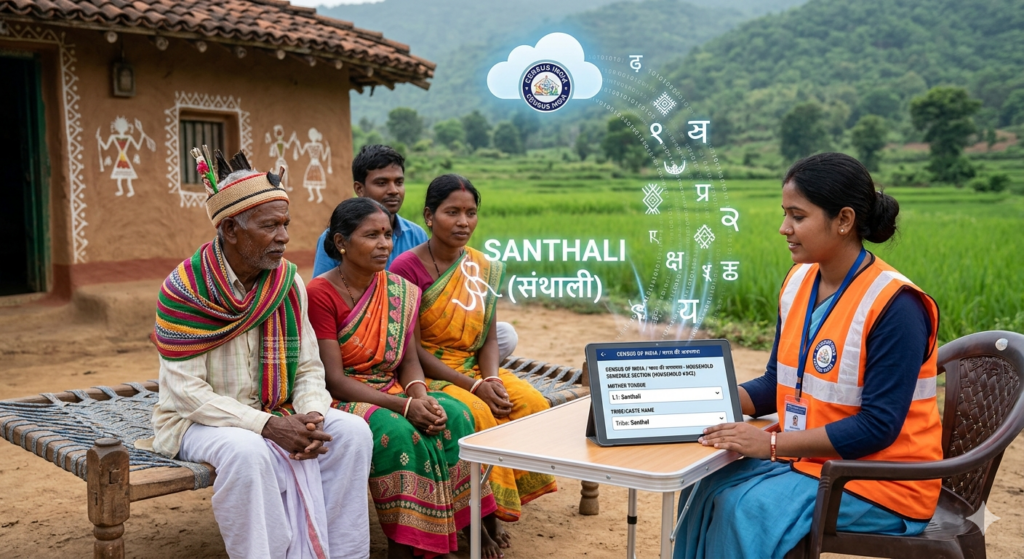
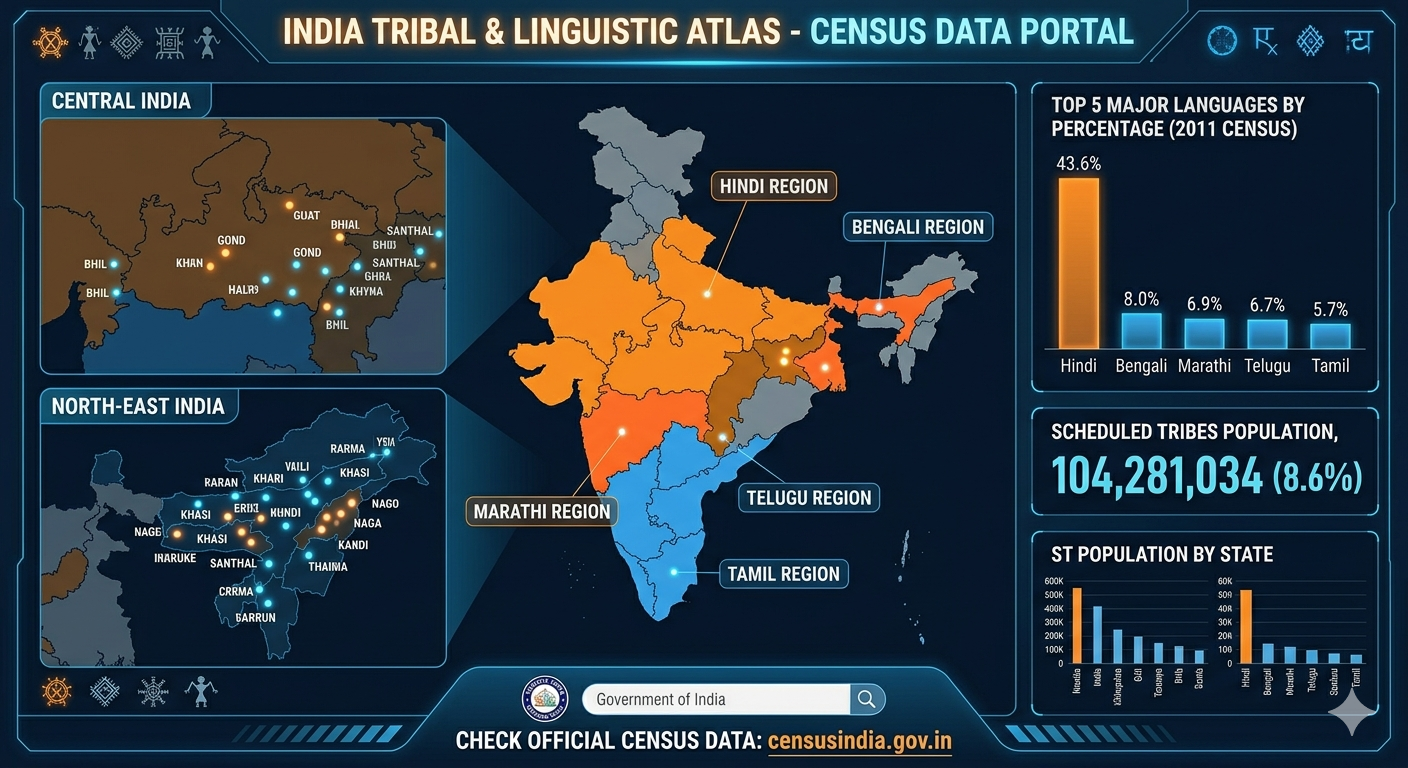
Image 2: Official Census Result Display Portal
This infographic serves as a mock-up of the official ‘CENSUS INDIA’ digital results portal (from Image 1). It displays a national data dashboard titled ‘INDIA TRIBAL & LINGUISTIC ATLAS – CENSUS DATA PORTAL.’ A large interactive map of India is visible, with major languages from the text—Hindi, Bengali, Marathi, Telugu, and Tamil—color-coded by region. Specific data graphs on ‘TOP 5 MAJOR LANGUAGES’ and ‘SCHEDULED TRIBES POPULATION’ provide numerical summaries.

