




By Westferry Times Editorial Team
A widely shared social media video featuring Rahul Gandhi—India’s Leader of the Opposition in the Lok Sabha since 2024—has intensified political debate over the country’s economic direction, governance, and international partnerships.
In the clip and related recent speeches, Gandhi raises concerns about Prime Minister Narendra Modi’s leadership, particularly questioning the integrity of economic decision-making and India’s relationship with the United States.
What Rahul Gandhi said
Across recent speeches and widely circulated clips, Gandhi has argued that:
- The government is prioritising large corporate interests over ordinary citizens
- Economic policies lack transparency and fairness
- India’s agreements with global powers—particularly the United States—may compromise national interests
In one of his strongest recent criticisms, Gandhi alleged that a trade understanding with the US favoured American interests and could harm India’s long-term economic sovereignty.
He has also used sharp political language to question the credibility of the government, accusing it of focusing on image rather than substance.
India–US relations: Why this matters
India and the United States have developed a strategic partnership in recent years, covering:
- Trade and investment
- Defence cooperation
- Technology and energy
Gandhi has previously acknowledged the importance of this relationship but warned that it must be balanced and equitable, ensuring India does not become economically dependent.
Key concern raised
His criticism centres on a fundamental question:
👉 Are international agreements being negotiated in India’s long-term interest—or influenced by political and corporate priorities?
Debate over integrity and governance
Gandhi’s remarks are part of a broader opposition narrative questioning:
- Transparency in policymaking
- The concentration of economic power
- The role of institutions in safeguarding democracy
He has also accused the government of using political strategy and “distraction” to avoid addressing core economic issues such as unemployment and inequality.
Government’s position
The Modi government has strongly rejected these claims, arguing that:
- India’s global standing has improved significantly
- Strategic partnerships, including with the US, are essential for growth
- Economic reforms are delivering long-term benefits
Supporters of the government highlight:
- Infrastructure expansion
- Digital transformation
- India’s rising geopolitical influence
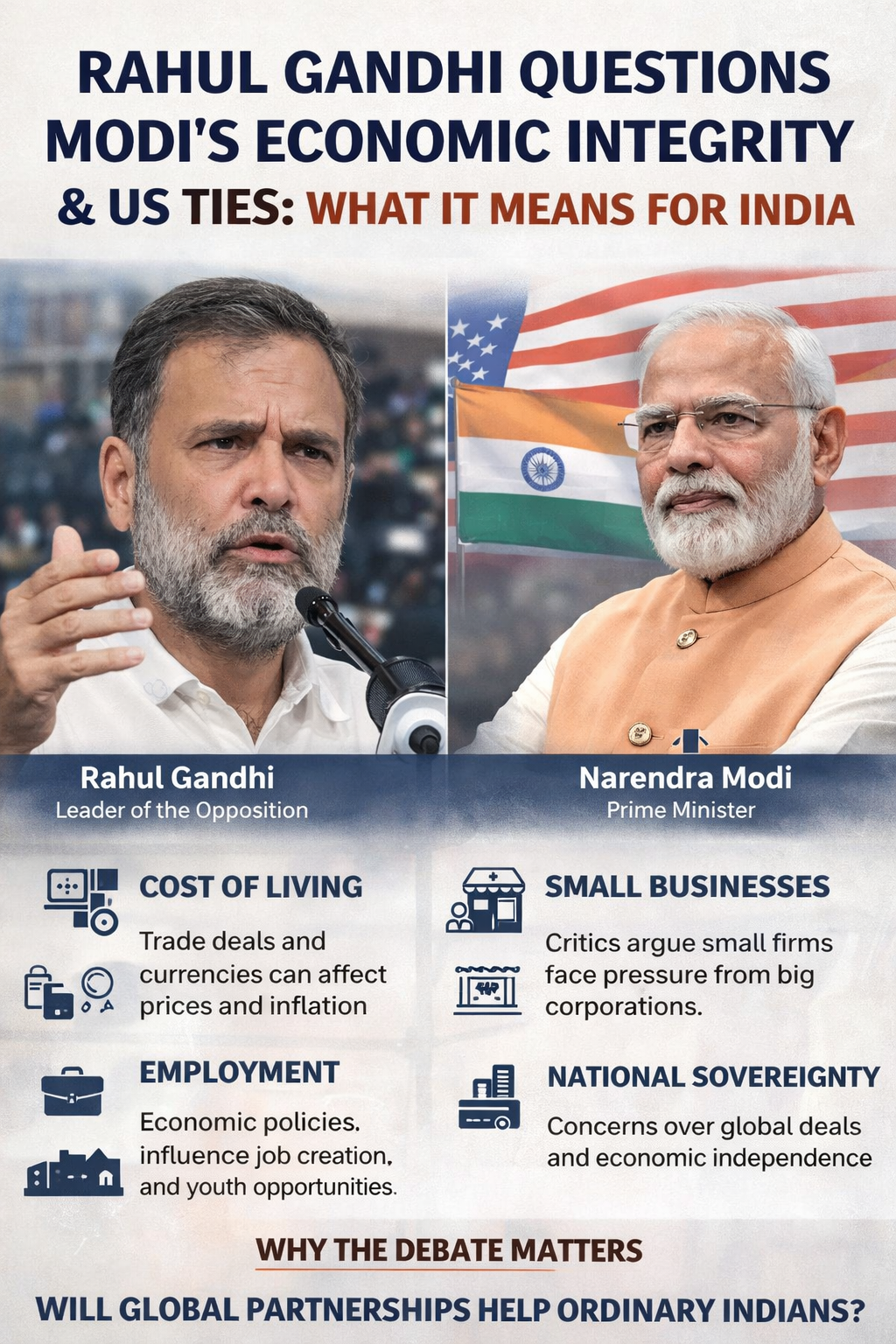
Impact on everyday Indians
While the debate may appear political, it has real implications for citizens:
1. Cost of living
Global trade deals and currency movements can influence:
- Fuel prices
- Imported goods
- Inflation
2. Employment
Economic policies affect:
- Job creation in manufacturing and services
- Opportunities for young people entering the workforce
3. Small businesses
Critics argue that:
- Smaller enterprises face pressure from large corporations
- Policy frameworks may not adequately support local industries
4. National sovereignty
Concerns over international agreements raise questions about:
- Control over key industries
- Economic independence
A wider political divide
The exchange between Gandhi and Modi reflects a deeper divide in India’s political discourse:
| Government Perspective | Opposition Perspective |
|---|---|
| Strong global partnerships drive growth | Partnerships must not compromise sovereignty |
| Economic reforms are working | Benefits are unevenly distributed |
| India is rising globally | Domestic challenges are being overlooked |
Why this debate is significant
India is at a critical stage in its development:
- It is one of the fastest-growing major economies
- It is strengthening global alliances
- It faces internal challenges such as inequality and job creation
The disagreement between Gandhi and Modi highlights a central issue:
👉 Should India prioritise rapid global integration, or focus more on internal economic balance and equity?
Conclusion
The viral video of Rahul Gandhi is not just a political moment—it reflects a larger national debate about growth, governance, and global influence.
As India deepens its ties with the United States and other global powers, the key question remains:
Will economic progress translate into tangible benefits for ordinary Indians?
References
- Reuters/Times of India reporting on Gandhi’s criticism of India–US deal
- Parliamentary role and background of Rahul Gandhi
- Coverage of Gandhi’s political arguments on governance and policy
- Reporting on India–US engagement and Gandhi’s remarks abroad

