




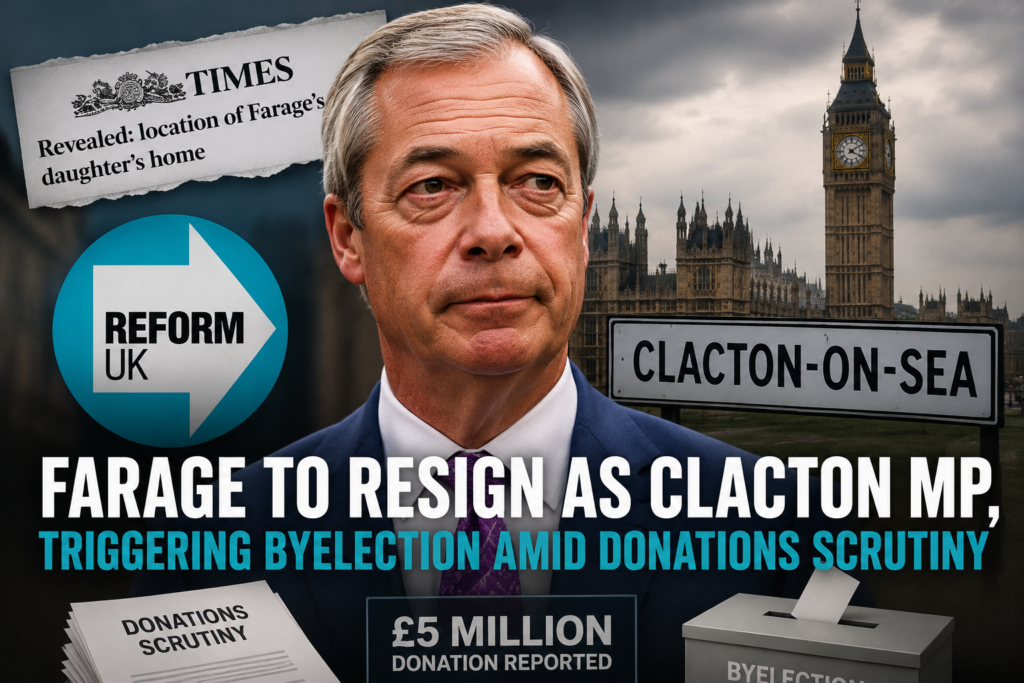
Nigel Farage announced on Tuesday that he will resign as the Reform UK MP for Clacton-on-Sea, forcing a byelection he is describing as a contest between “the people” and “the establishment.” He confirmed he intends to stand again in the seat he currently holds.
A Breaking Point
Farage framed his decision as the result of mounting personal and political pressure, pointing in particular to a recent Times report that revealed the location of his daughter’s home. He said the story crossed a line, arguing his daughter has no involvement in public life and accusing the paper’s editor of endangering her safety. He also criticised broadcasters, including Sky News, for what he described as dishonest reporting around the story.
Rather than step back from politics, Farage said he had decided to put the matter directly to voters, framing the byelection as a chance for Clacton residents to judge his conduct themselves.
Financial Scrutiny
The announcement comes as Farage faces renewed scrutiny over his personal finances, including a reported £5 million gift from businessman Christopher Harborne, which Farage likened to winning the lottery, and a fresh standards investigation connected to a Sunday Times report on donations linked to George Cottrell. Farage maintains he has broken no rules, arguing that parliamentary standards govern MPs’ public conduct rather than their private financial affairs, and that having wealth or outside income is not itself improper.
He also pushed back on Labour’s tightening of rules around political donations from overseas donors, describing the changes as a deliberate attempt to disadvantage Reform UK.
Political Reaction
Liberal Democrat leader Ed Davey was quick to respond, dismissing the byelection as an attempt by Farage to avoid accountability rather than face it. Farage, for his part, argued that the political establishment has turned to “foul means” because it cannot defeat Reform UK through ordinary electoral competition, pointing to the party’s recent electoral performance as evidence it cannot be beaten fairly.
Commentators, including the Financial Times‘ Robert Shrimsley, suggested the byelection strategy may be a calculated move — a way for Farage to seize back control of the narrative rather than simply absorb the criticism.
What Happens Next
With Farage’s resignation, a byelection in Clacton is expected to be called in short order. Farage has said he intends to contest the seat directly, betting that voters — rather than the press, other parties, or parliamentary standards processes — should be the ones to decide his political future.
The Electoral Commission is also separately being asked by Labour to investigate whether Farage broke electoral law by failing to disclose gifts.
This is a fast-moving political story; details may continue to develop.

