




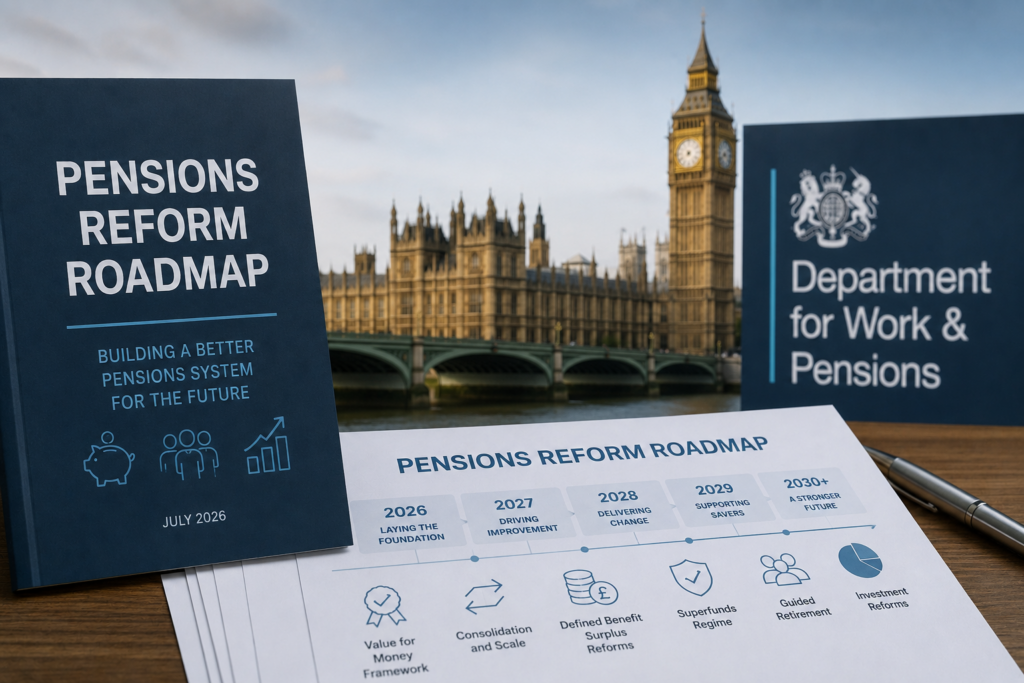
July 2026
The UK government has published a comprehensive roadmap outlining the next phase of workplace pension reforms, providing pension providers, employers and regulators with a clearer timeline for changes expected over the coming years.
The roadmap, developed jointly by the Department for Work and Pensions (DWP), HM Treasury, the Financial Conduct Authority (FCA) and The Pensions Regulator (TPR), aims to coordinate one of the largest programmes of pension reform in decades.
Delays to Key Reforms
Among the most notable announcements is the decision to postpone several major initiatives, including the Value for Money (VfM) framework, the superfund regime and guided retirement reforms.
The government said the revised timetable reflects industry concerns about the complexity of implementing multiple reforms simultaneously while ensuring schemes have sufficient time to prepare.
Guided retirement reforms will now be introduced alongside regulations governing multi-employer Collective Defined Contribution (CDC) pension schemes, allowing providers greater flexibility when developing retirement income solutions.
A Five-Year Plan
The roadmap sets out a structured implementation schedule covering the next five years, with the objective of improving coordination between regulators and reducing uncertainty across the pensions sector.
The reforms cover a wide range of areas, including:
- Defined contribution pension schemes
- Value for Money assessments
- Pension scheme consolidation
- Defined benefit surplus rules
- Superfund regulation
- Retirement guidance
- Investment reforms
Government officials say sequencing reforms more carefully will help providers deliver changes more efficiently while maintaining protection for pension savers.
Industry Welcomes Greater Certainty
Pensions professionals have broadly welcomed the publication of the roadmap, describing it as an important step toward improving long-term planning.
Industry representatives said pension providers have adapted successfully to significant regulatory change in recent years but stressed that clear implementation schedules are essential to avoid unnecessary disruption.
Many organisations also urged ministers to minimise additional policy changes while existing reforms are being delivered.
Calls for Long-Term Policy Stability
Several experts warned that the sector is already preparing for a number of significant changes beyond the current roadmap.
These include upcoming changes affecting pension taxation, increases to the minimum pension age and future reforms to salary sacrifice arrangements.
Industry leaders argued that introducing further major policy changes during this period could increase operational complexity for pension providers and create confusion for savers.
They emphasised that long-term consistency remains essential for employers, pension schemes and individuals planning for retirement.
Political Uncertainty Raises Questions
The publication of the roadmap also comes during a period of political uncertainty, with speculation surrounding possible ministerial and cabinet changes.
Some pensions experts noted that reforms extending beyond the current parliamentary term may require continued political support to ensure successful implementation.
Without sustained backing across future governments, there are concerns that parts of the programme could face delays or revisions before completion.
Focus on Better Retirement Outcomes
Despite the challenges ahead, the government’s roadmap reflects a broader strategy to modernise the UK’s pensions system while improving value, transparency and retirement outcomes for millions of workers.
Regulators and policymakers hope that clearer planning, closer cooperation and phased implementation will enable the industry to deliver reforms without placing unnecessary pressure on schemes or pension savers.
Looking Ahead
The roadmap provides pension providers with greater visibility over future regulatory expectations while giving the industry an opportunity to prepare for significant structural changes.
Although implementation timelines have shifted for several initiatives, the government has indicated that pension reform remains a priority and that the revised schedule is intended to improve delivery rather than slow overall progress.
As consultations continue, pension providers, trustees and employers will closely monitor further announcements to understand how the reforms will shape the UK’s retirement savings landscape over the coming years.

