




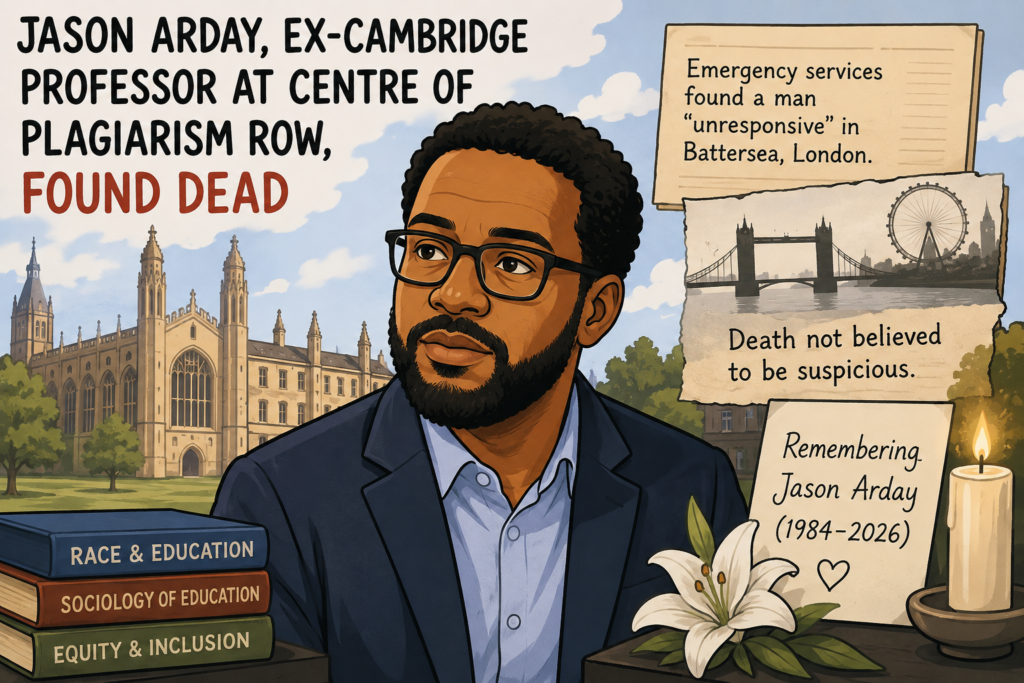
Jason Arday, the former University of Cambridge professor who recently resigned amid a highly publicised plagiarism controversy, has died at the age of 41.
Arday was found unresponsive at an address in Battersea, south London, on Friday afternoon, according to emergency services. The Metropolitan Police said his death was being treated as unexpected but was not believed to be suspicious.
His death comes only days after he stepped down from his position as professor of sociology of education at the University of Cambridge following allegations concerning plagiarism and questions surrounding parts of his academic record. Arday denied deliberately plagiarising material but acknowledged errors in some of his earlier work.
Family Pays Tribute
Arday’s family said they were devastated by his death, describing him as an “amazing father, partner, brother, uncle and son”.
In a statement, the family said the intense public controversy and what they described as a campaign of misinformation had placed an enormous burden on him.
Cambridge Vice-Chancellor Professor Deborah Prentice also expressed her sadness, offering condolences to Arday’s family and friends.
Education Secretary Lucy Powell said she was deeply shocked by the news and called for people to remember the human beings and families involved in the controversy.
Plagiarism Allegations and Academic Scrutiny
The controversy surrounding Arday intensified after academic Nathan Cofnas raised allegations of plagiarism in his published work. Arday rejected the allegations and said that mistakes in some of his early academic writing were connected to how he processed and understood information.
He argued that the intense scrutiny had gone beyond normal academic disagreement and had resulted in what he described as sustained personal attacks.
Arday resigned from Cambridge last week, saying the personal cost of the controversy had become too great. In his resignation statement, he said criticism was a normal part of academic life but argued that the level of accusations, speculation and public commentary directed towards him had gone far beyond scholarly debate.
Investigations Into His Academic Work
The University of Cambridge had already faced questions about Arday’s appointment and announced an independent investigation into the circumstances surrounding it.
Cambridge previously said claims concerning Arday’s thesis and some journal publications had been examined by Liverpool John Moores University and the relevant journals. Liverpool John Moores University, which awarded Arday his PhD in 2015, concluded that he had not plagiarised his work.
The University of Glasgow, where Arday had previously worked, also announced a review of his academic work following the controversy.
A Remarkable Academic Journey
Arday’s career had been notable for the challenges he overcame.
He initially worked as a physical education teacher before completing his doctorate and progressing through academic positions at Durham University and the University of Glasgow.
In 2023, he was appointed as a professor of sociology of education at Cambridge at the age of 37, an appointment that attracted significant attention. Cambridge highlighted the significance of his appointment at a time when only around 1% of professors at UK universities were Black.
His life story was also the subject of his memoir, Great And Unfortunate Things. The book describes his experiences growing up, including being non-verbal until the age of 11 and unable to read or write until 18, before eventually pursuing an academic career.
Questions for Cambridge
Arday’s death is likely to intensify questions surrounding the university’s handling of the controversy and its responsibilities towards academics facing intense public scrutiny.
The independent investigation into his appointment was announced shortly before his death. Cambridge has said the review will be conducted independently and will examine the concerns that have been raised.
For now, Arday’s family, former colleagues and universities where he worked are mourning his death.
His story has moved rapidly from one of academic achievement and controversy to tragedy, raising difficult questions about public scrutiny, institutional responsibility and the human cost of prolonged controversy.

