



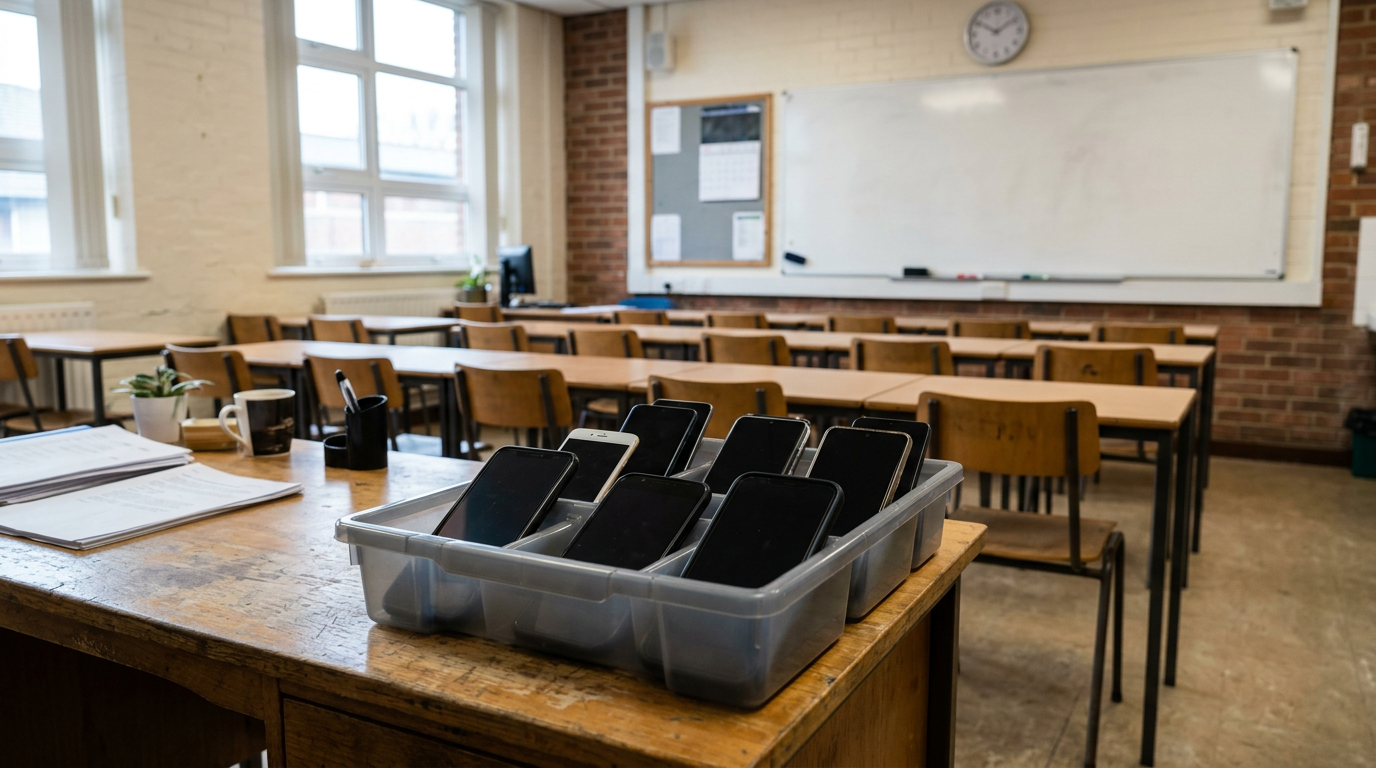

Analysis: England is moving towards phone-free schools. We weigh the research behind the policy, and the studies that question it.
Does a smartphone ban in schools work? The evidence is split by what you measure. Studies of exam results suggest that well-enforced bans can modestly raise attainment, especially for lower-achieving pupils. But the largest English study of wellbeing found no difference in pupils’ mental health between schools that restrict phones and schools that do not, partly because pupils simply used their phones more after school. A ban is a reasonable tool for reducing distraction in lessons. On current evidence, it is not a cure for the wider harms linked to smartphones and social media.
What the rules say in England
Education is devolved, so this section covers England. The Department for Education first issued guidance in 2024 recommending that schools prohibit phone use throughout the school day. It was strengthened on 26 January 2026. According to summaries by the law firms Irwin Mitchell and Geldards, the updated guidance says schools should be mobile phone-free by default, covering lessons, the time between lessons, breaks and lunchtimes, with any other approach treated as an exception. It also says phones should not be part of “bring your own device” schemes, and Ofsted looks at schools’ phone policies as part of inspections.
The guidance now has legal backing, but England does not have an outright statutory ban. In April 2026 the government said it intended to give legal force to what schools were already doing, and on 20 April peers voted by a majority of 107 for a Conservative amendment to the Children’s Wellbeing and Schools Bill to ban pupils from having smartphones during the school day. The bill received Royal Assent on 29 April 2026. Under section 36 of the Children’s Wellbeing and Schools Act 2026, in force since 29 June 2026, head teachers or, for some schools, proprietors in England must have regard to the Secretary of State’s guidance on pupils having and using mobile phones during school hours. In effect, the DfE guidance became statutory guidance. The law firm Browne Jacobson notes that phones are not prohibited items in law and that how schools achieve a phone-free day is left to school leaders. This is the position as of October 2026.
In practice, many schools already restrict phones in some way, although definitions vary widely, as our fact check on how many schools ban mobile phones explains.
The case for a smartphone ban in schools
Better results, especially for struggling pupils
The study most often cited by supporters was carried out in England. Economists Louis-Philippe Beland and Richard Murphy, in work published through the London School of Economics’ Centre for Economic Performance in 2015, surveyed 91 secondary schools in Birmingham, Leicester, London and Manchester about when they introduced phone bans, and linked this to national exam data from 2001 to 2011.
After a ban, GCSE-age test scores rose by about 6.4% of a standard deviation, which the authors likened to an extra hour of schooling a week. The gains were concentrated among the lowest-achieving pupils, whose scores rose by about 14% of a standard deviation, while high achievers were not significantly affected. Crucially, the effect only appeared where schools reported that the ban was well enforced.
More face-to-face time and clearer rules
Qualitative research from the University of Birmingham, published in March 2026, interviewed 177 pupils, staff and parents across seven schools. In schools with restrictive policies, pupils spent more time socialising face to face during the day. Supporters also argue that a single national expectation helps head teachers enforce rules without negotiating with every family, and removes the social pressure on individual pupils to be constantly online.
The case against a blanket ban
No measurable wellbeing benefit in the largest English study
The SMART Schools study, led by Dr Victoria Goodyear at the University of Birmingham and published in The Lancet Regional Health – Europe in February 2025, compared 1,227 pupils aged 12 to 15 in 30 English secondary schools. Twenty had restrictive policies and ten were more permissive.
Pupils in restrictive schools used their phones for about 40 minutes less during the school day and spent around half an hour less on social media in school time. But there was no evidence of a difference in mental wellbeing, and no difference in total phone or social media use across weekdays or weekends. In a linked commentary, Helen Weiss and Chris Bonell of the London School of Hygiene and Tropical Medicine noted that the study also found no differences in anxiety, depression, sleep, physical activity or attainment. The authors concluded that bans in their current form were not supported by their findings.
Problems that follow pupils through the gates
The 2026 Birmingham research found that some pupils in restrictive schools made up for lost phone time by sleeping less, exercising less or skipping homework. In both kinds of school, conflicts and bullying that started online outside school carried into the school day. Pupils in permissive schools showed more ability to regulate their own phone use, although they also faced problems such as photos being taken without consent.
Equality and safeguarding duties
Some pupils rely on phones for medical monitoring, safeguarding or additional learning needs. Geldards warns that a blanket ban which fails to accommodate such needs is unlikely to be lawful, and advises schools to align phone policies with their special educational needs policies.
Why the studies seem to disagree
The two strongest English studies are not really in conflict, because they measure different things:
- Attainment versus wellbeing. The LSE work looked at exam results; SMART Schools focused on mental wellbeing. A ban can reduce classroom distraction without changing how teenagers feel overall.
- Enforcement. The exam gains appeared only where bans were properly enforced. A rule on paper may do little.
- Time period. The LSE data covered 2001 to 2011, when smartphones and social media were far less central to teenage life than today.
- Study design. Neither study randomly assigned schools to ban phones. SMART Schools had a low school response rate and a cross-sectional design; the LSE study relied on head teachers recalling past policies.
Weiss and Bonell add a wider caution: although smartphone and social media use is plausibly linked to poorer adolescent mental health, the evidence that one causes the other remains weak, because most studies are cross-sectional and the relationship may run both ways.
What the evidence does and does not show
The evidence gives reasonable support to restricting phones during lessons and the school day as a way to reduce distraction, particularly for pupils who struggle most. It gives much weaker support to the idea that school bans alone will improve teenagers’ mental health, because most phone and social media use happens outside school hours.
That is why many researchers argue that school policies need to sit alongside other measures: support for parents, attention to sleep and in-person activities, and regulation of the online platforms themselves. The debate over a bill to limit the harms of smartphone use among children reflects the same tension between school rules and the wider digital world.
Frequently asked questions
Are mobile phones banned in schools in England?
Not by an outright legal ban. As of October 2026, DfE guidance says schools should be phone-free by default throughout the school day, and since 29 June 2026 schools have had a legal duty, under the Children’s Wellbeing and Schools Act 2026, to have regard to that guidance. Ofsted looks at schools’ phone policies as part of inspections.
Do phone bans improve exam results?
An LSE-published study of English schools found modest gains after bans, mostly among lower-achieving pupils and only where bans were well enforced.
Do school phone bans improve mental health?
The largest English study so far, SMART Schools, found no evidence of better mental wellbeing in schools with restrictive policies, although pupils there used phones less during school hours.
Can schools make exceptions?
Yes. Lawyers advise that schools must consider medical, safeguarding and special educational needs, and that a ban with no room for such exceptions is unlikely to be lawful.
Sources: Irwin Mitchell, New government guidance on mobile phones in schools (28 January 2026); Geldards, Mobile phone bans in schools: the current landscape and emerging changes (5 May 2026); Beland and Murphy, Ill Communication: Technology, Distraction and Student Performance (working paper) (May 2015); Teacher Magazine, Mobile phones in the classroom (26 May 2015); University of Birmingham, School phone policies and their association with mental wellbeing (The Lancet Regional Health – Europe) (4 February 2025); Weiss and Bonell, Smartphone use and mental health: going beyond school restriction policies (8 February 2025); University of Birmingham, School phone bans or not, digital lives of students affect the school day (18 March 2026); legislation.gov.uk, Children’s Wellbeing and Schools Act 2026, section 36 (Royal Assent 29 April 2026); Browne Jacobson, Mobile phones in schools (13 July 2026).

