



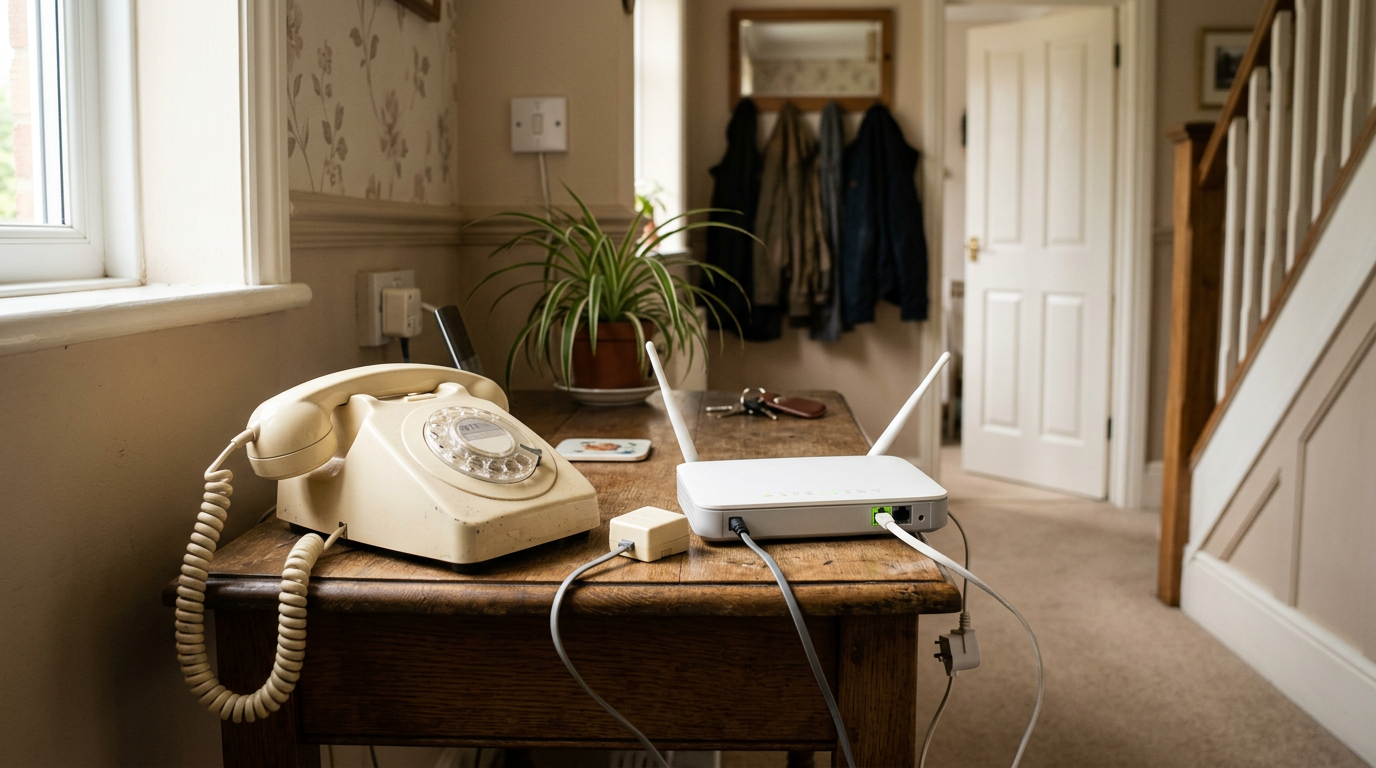

The UK landline switch-off means the old copper telephone network, known as the PSTN, is due to close on 31 January 2027. Home phones are moving to “digital” lines that carry calls over a broadband connection instead. For most households the change is simple: your phone provider contacts you, and you plug your handset into your broadband router rather than the wall socket. But people who rely on telecare alarms, have no broadband, or live where power cuts are common need to act early. This guide explains what is changing, what you need to do and what protections exist, as of October 2026.
What is the landline switch-off?
For decades, home phones have run on the Public Switched Telephone Network (PSTN), an analogue system powered from local telephone exchanges. The telecoms industry is retiring it. Government guidance for councils, updated on 19 October 2026, explains that the network is ageing, that spare parts are no longer being made, and that reported incidents on it rose by 45% in 2024.
Calls will instead use internet technology, often called Voice over IP (VoIP) or “digital voice”. The government says digital lines offer clearer calls, better reliability and better tools for blocking scam calls.
Is it the end of copper broadband too?
Not yet. The January 2027 deadline is about the analogue phone service. Separately, Openreach is gradually stopping sales of older copper-based broadband in areas where full fibre is available, exchange by exchange. That is a slower process that will run well beyond 2027, and homes without full fibre keep their existing services in the meantime.
Key dates for the landline switch-off
- 5 September 2023: Openreach stopped selling new analogue phone lines nationally.
- 31 January 2027: the PSTN is due to close. The date was moved from the original December 2025 target in 2024.
- From 1 February 2027: any remaining lines move to a temporary, limited emergency service (see below).
Progress is well advanced. According to Openreach figures reported by ISPreview in September 2026, around 15 million lines have already moved, while about 1.2 million had yet to switch, including roughly 350,000 business premises.
What households need to do
1. Wait for your provider, and check it is genuine
The company you pay for your phone line should contact you before your line is moved. Government guidance advises watching for official communications from your provider and not confusing them with sales marketing. Because switchover messages are an obvious hook for fraudsters, never give bank details to an unexpected caller; ring your provider back on the number on your bill.
2. Move your phone to the router
If you already have broadband, the switch may be as simple as unplugging your handset from the wall socket and plugging it into the phone port on your router. Some homes may need an engineer visit to confirm everything works.
3. Check anything else connected to your phone line
This step is easy to overlook. Telecare and personal alarms, security alarms, door-entry systems and some older devices use the phone line too. The government advises checking with the equipment maker whether each device will work on a digital line. A survey commissioned by broadband firm CommunityFibre in August 2026 suggested only 12% of landline users had checked their equipment, though the company has a commercial interest in the issue.
4. Plan for power cuts
The biggest practical difference is power. Old analogue phones drew power from the exchange, so they often worked during a power cut. A digital phone relies on your router, which needs mains electricity. If the power goes off, a digital landline will stop working unless there is a battery back-up.
A mobile phone is the simplest fallback for many people. If you have no mobile signal at home or depend on your landline, tell your provider (see the protections below).
More Read

Protections for vulnerable people and telecare users
Ofcom, the communications regulator, has made clear that providers must protect customers during the move. Its rules and guidance say:
- Providers must have at least one way for customers to reach the emergency services for a minimum of one hour during a power cut at home, such as a battery back-up unit or a suitable mobile phone.
- That solution should be suitable for the customer and free for at-risk customers who depend on their landline. Providers should also explain the risk and tell customers how to ask for help.
- Providers must identify, protect and support vulnerable customers through the switchover, and Ofcom says it will take enforcement action against those that fail.
Telecare users get extra help. The government says providers offer them free engineer visits and battery back-ups for telecare devices and landlines where needed. Openreach runs a service that sends trained engineers to test telecare equipment on the new digital line before the upgrade, and says it has moved more than 70,000 telecare customers safely. If you or a relative uses a pendant alarm, tell both your phone provider and your alarm provider now rather than waiting.
What if you do not have broadband?
You do not have to buy a full broadband package just to keep a home phone. Government guidance says customers without broadband may be offered an interim dedicated landline service until a digital option is available, or until 2030, whichever comes first. Ask your provider what it offers.
What happens if you have not switched by 31 January 2027?
Homes will not simply be cut off on the day. Openreach has confirmed a temporary safety net called Emergency Voice Access (eVAC) for lines that have not moved. It is a limited, last-resort service for essential calls, and Openreach has described it as more expensive than modern digital alternatives, with higher wholesale charges from 1 February 2027. It is a stopgap, not a reason to delay. As Openreach’s James Lilley put it: “No one should wait for the PSTN to close before upgrading.”
Advice for small businesses
Business lines have historically had fewer protections than household lines. The government advises firms to audit everything that relies on the old network, including phones, alarms, card payment terminals, lift emergency phones and intercoms, and to expect to upgrade or replace some equipment. Talk to your provider and equipment suppliers well before January. If connectivity is critical, consider back-up options, as broadband outages such as the TalkTalk outage earlier this year will now take phone service down with them.
Frequently asked questions
Does the landline switch-off affect my broadband?
The January 2027 deadline concerns the analogue phone service. Withdrawal of older copper broadband is a separate, slower process that happens area by area once full fibre is available.
Will my phone work in a power cut?
Not without a back-up power source, because digital phones run through your router. Ofcom requires providers to offer at least one hour of emergency access in a power cut, free to at-risk customers who depend on their landline.
Do I have to pay for the switch?
Telecare users can get free engineer visits and battery back-ups where needed. For others, costs depend on your provider and package, so ask before agreeing to any change, and be wary of anyone pressuring you to sign up on the spot.
Is the 31 January 2027 date final?
As of October 2026, Openreach says the closure date is unchanged. Remaining lines will move to the temporary eVAC service rather than being disconnected outright.
Sources: DSIT and DCMS, UK transition from analogue to digital landlines: guidance for local authorities (updated 19 October 2026); Ofcom, Protecting customers during the migration to digital landlines (18 December 2023); Ofcom, Guidance on emergency access during a power cut (10 October 2018); ISPreview, Openreach confirm post-January 2027 measures for UK analogue phone switch-off (24 September 2026); ISPreview, Openreach name next 112 UK areas for copper to full fibre switch (8 October 2026); ISPreview, 45 percent of UK landline users confused by analogue phone switch-off (26 August 2026); ISPreview, Openreach update as analogue UK phone switch-off delayed to 2027 (17 May 2024).

