



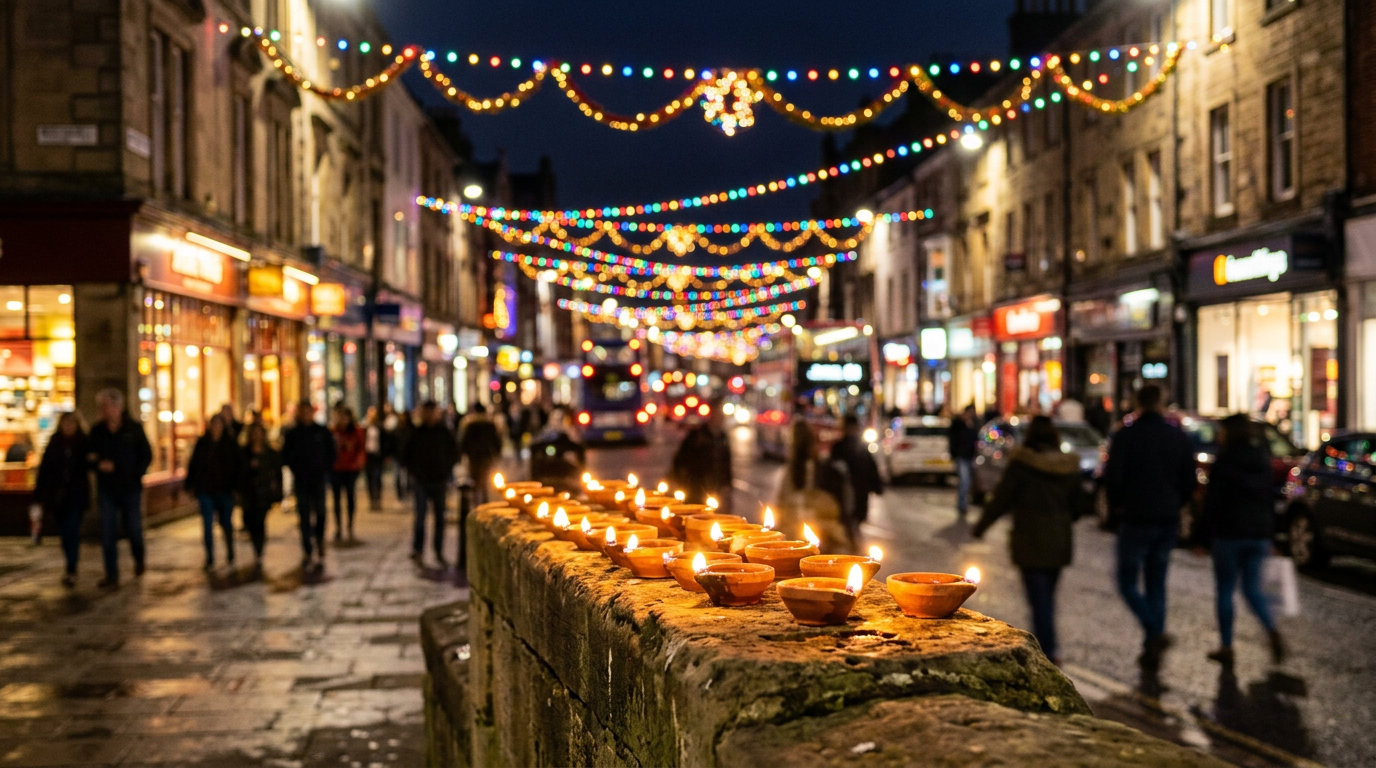

Diwali in Britain has grown from a festival kept mostly at home by South Asian families in the 1950s and 1960s into one of the country’s biggest public celebrations, with Leicester’s Golden Mile drawing crowds of tens of thousands. The festival of lights is observed by Hindus, Sikhs and Jains, and in 2026 the main day of Diwali falls on Sunday 8 November, the date Leicester has set for its Diwali Day celebrations.
This guide explains what Diwali means, why it matters to different faiths, how it took root in British cities, and what to expect this year.
What is Diwali?
Diwali, also called Deepavali, is a festival of lights that celebrates the victory of light over darkness. Writing for the Open University, Suzanne Newcombe explains that the name comes from Sanskrit words meaning a row of lamps, and that the root word for lamp can also suggest knowledge. The festival is older than its earliest written references.
Diwali falls on the new-moon night of the Hindu lunar month of Kartik, which is why its date moves each year, usually landing between mid-October and mid-November. Celebrations stretch over several days, and different communities give weight to different days within that period.
The Hindu stories behind Diwali
The best-known story comes from the Ramayana. Prince Rama, his wife Sita and his brother Lakshmana return to the city of Ayodhya after 14 years of exile and the defeat of the demon king Ravana, and the people light lamps to welcome them home. In southern India, the festival is more often linked to Krishna and his wife Satyabhama defeating the demon Narakasura.
Diwali is also closely associated with Lakshmi, the goddess of wealth and prosperity. Material presented by Google Arts & Culture with partners including the British Museum notes the belief that Lakshmi emerged during the churning of the cosmic ocean on Diwali, and that farmers offer their harvest to her, since Kartik marks the end of the harvest season. In many communities the Hindu new year begins as the Diwali days draw to a close.
Why Diwali matters to Sikhs and Jains
Diwali is not only a Hindu festival. For Sikhs, the same day is Bandi Chhor Divas. It commemorates the release in 1619 of Guru Hargobind, the sixth Sikh Guru, from Gwalior Fort, where he had been held by the Mughal emperor Jahangir. According to an explainer from University Hospitals of Derby and Burton NHS Foundation Trust, the Guru refused to leave unless 52 imprisoned Hindu princes were freed too. Told that only those who could hold on to his cloak could go, he had a cloak made with 52 tassels so that every prince walked out with him. When the Guru reached Amritsar, Diwali celebrations were already under way, which is why Sikhs mark his release on the same day. He became known as Bandi Chhor, the liberator of the imprisoned.
For Jains, the festival marks the moment when Mahavira, a tirthankara or great spiritual teacher, attained moksha, or liberation, in the sixth century BCE. The Open University notes that some Buddhist communities also observe the festival.
More Read
How Diwali came to Britain
Leicester’s story shows how Diwali in Britain moved from front rooms to high streets. The city council’s Story of Leicester heritage project says that Hindu and Sikh settlers who arrived from India and East Africa in the 1950s and 1960s largely kept their faith at home, though Diwali remained an important date for them.
That changed after 1972, when Asians expelled from Uganda began settling in Leicester. Demand for festivities grew, and more Asian-owned shops opened on Belgrave Road, stocking the ingredients families needed for traditional Diwali food. In 1977 the council opened the Belgrave Neighbourhood Centre in a former Methodist church on the road, and it became a focal point for later celebrations.
The Golden Mile lights
The first public Diwali lights went up in 1983, stretching along Belgrave Road from Dorset Street to Loughborough Road, and were switched on by the community’s oldest resident. By the 1990s the celebrations had a national profile. The University of Leicester sponsored the 40th annual switch-on in 2023, when crowds of more than 30,000 were expected.
Today the Story of Leicester project counts around 6,500 lights along Belgrave and Melton Roads, the stretch known as the Golden Mile, with about 50 events across two weeks. Research by Suzy Harrison in the journal Ritual Year traces how the city council’s festivals team revamped the programme in 2015 to present it as a celebration of Leicester’s multicultural heritage. She reports that up to 40,000 people attend the switch-on and Diwali Day, and describes the events as “some of the biggest outside of India”.
Leicester is not alone. The Open University points to large celebrations in other cities with substantial Indian-heritage populations, such as Birmingham, while gurdwaras and mandirs across the UK hold their own services and gatherings.
Diwali in Britain 2026: what is happening
As of late October 2026, Leicester City Council says the traditional lights are once again illuminating the Golden Mile, with a Wheel of Light on Belgrave Road running until Diwali Day. Key events include:
- Saturday 7 and Sunday 8 November: a rangoli exhibition at the Belgrave Neighbourhood Centre.
- Sunday 8 November, Diwali Day: a Diwali village at Cossington Street Recreation Ground with food stalls, a family funfair and a community stage, including a puja ceremony led by the Leicester Hindu Festival Council.
- The finale: a new production led by the Aakash Odedra Company combining Bollywood dance, theatre and orchestral music, followed by an aerial performance and a laser show.
Venues including Leicester Cathedral, Curve, the Haymarket Theatre, the Peepul Centre and Attenborough Arts Centre are also hosting events. Councillor Vi Dempster, the assistant city mayor for culture, called Diwali “one of the highlights of Leicester’s cultural calendar”.
Families celebrating at home should note that the Fireworks Regulations 2004 make Diwali one of four nights of the year when fireworks may be let off after the usual 11pm curfew, in this case until 1am the following morning.
How Diwali is celebrated at home
Customs vary between families, regions and faiths, but common traditions include:
- Lighting lamps: small clay lamps called diyas, along with strings of lights, are placed on walls and around doorways.
- Rangoli: colourful decorative patterns, an art form Leicester celebrates with its own Diwali exhibition.
- Worship: prayers at home, in mandirs or, for Sikhs, at the gurdwara.
- Food and gifts: sweets are shared with family, friends and neighbours, and many people buy new clothes.
- Fireworks: displays, both public and private, light up the night.
Several of the days around Diwali carry their own meaning. Our earlier explainers on Dhanteras, which opens the festival, and Govardhan Puja, which follows it, look at those traditions in more detail.
Frequently asked questions
When is Diwali 2026 in the UK?
The main day of Diwali falls on Sunday 8 November 2026. Leicester’s Diwali Day celebrations take place on the same date.
Why does the date of Diwali change every year?
Diwali follows the Hindu lunar calendar and falls on the new-moon night of the month of Kartik, so its date on the Western calendar shifts, usually between mid-October and mid-November.
When did Leicester’s Diwali lights start?
The first public Diwali lights on Belgrave Road were switched on in 1983, according to Leicester City Council’s Story of Leicester project.
What is Bandi Chhor Divas?
It is the Sikh celebration held on the same day as Diwali, marking Guru Hargobind’s release from Gwalior Fort in 1619 together with 52 imprisoned princes.
Can you set off fireworks late on Diwali?
Yes, within limits. Under the Fireworks Regulations 2004, fireworks may be used until 1am on the night of Diwali, instead of the usual 11pm cut-off.
Sources: The Open University (OpenLearn), What is Diwali? (updated 8 November 2023); Google Arts & Culture, 5 amazing facts about Diwali (accessed October 2026); University Hospitals of Derby and Burton NHS Foundation Trust, What is Bandi Chhor and why is it celebrated? (4 November 2021); Leicester City Council, Story of Leicester: Diwali in Leicester (accessed October 2026); Suzy Harrison, The Development and Management of a Transnational Tradition: The Case of Diwali in Leicester, Ritual Year (2021); University of Leicester, University of Leicester boost for city’s landmark Diwali event (2023); Leicester City Council, Leicester set for sparkling Diwali celebrations (27 October 2026); legislation.gov.uk, The Fireworks Regulations 2004, regulation 7 (2004).

