



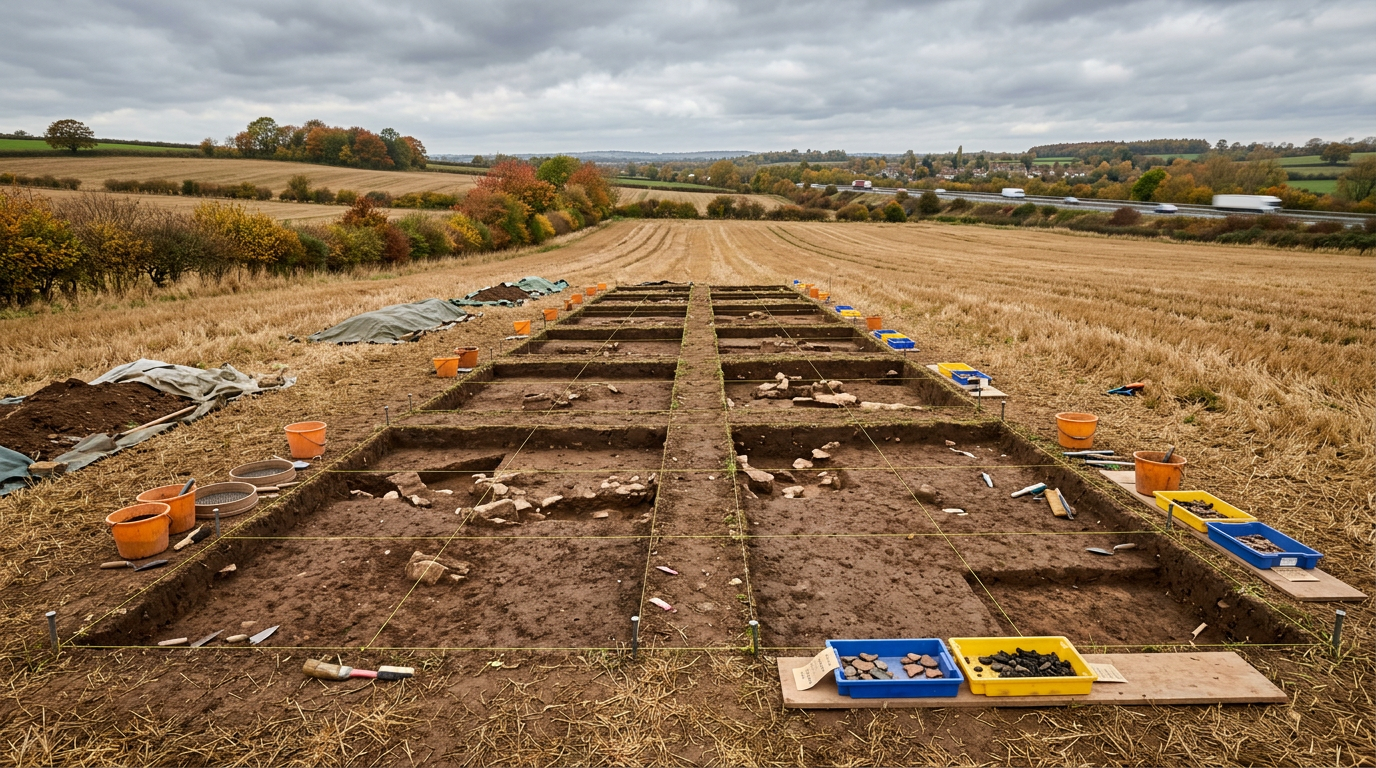

Archaeologists working ahead of a major motorway upgrade near Cheltenham have uncovered a Roman burial ground containing more than 100 graves, over half of them unusual “non-normative” burials, including people who had been decapitated or laid to rest in a crouched position. The site, at Junction 10 of the M5 in Gloucestershire, was shown to local residents in mid-October 2026, and the excavators say it could prove to be of national significance.
The find was reported by BBC News on 16 October. The dig is being carried out by Archaeological Research Services (ARS) for the contractor Galliford Try as part of Gloucestershire County Council’s M5 Junction 10 improvement scheme, according to ARS.
What was found at the Roman burial ground
Ada Torka-Lis, a project officer for ARS, told the BBC that more than 100 burials had been recorded so far, and that more than 50 of them were classed as non-normative, meaning the bodies were treated in ways that differ from the standard practice of the time. Some individuals had been decapitated; others were buried crouched rather than lying flat.
Such burials are known from other Roman sites in Britain, but Torka-Lis said they usually make up only a few per cent of a Roman cemetery. The proportion here is far higher, and she said the site had produced finds she had not seen anywhere else in the UK.
The burial ground is believed to date mainly from the Roman period, but the wider excavation has turned up evidence from several eras, including Palaeolithic and Anglo-Saxon material. Finds include brooches, bracelets, pottery, bricks and tiles, which Torka-Lis described as beautifully preserved.
Earlier discoveries on the same scheme
The cemetery is the latest of several finds along the route. In a blog post in June, ARS described a burial found on the scheme in which the skull had been removed and placed between the person’s knees, a practice it said is occasionally found in eastern England and the Midlands in the later Roman period. In a further post published in July, ARS described a fourth-century AD burial from one of its sites near Cheltenham in which a small group of grave goods had been placed with the dead person. At an archaeology open day reported by Punchline Gloucester in August, the team showed Roman coins, bracelets and jewellery, one piece of which was found with a skeleton, along with pottery from France that suggests the area was connected to wider trade routes.
More Read
What happens next
All the material will now go to specialists. Human and animal bones, coins and other objects will be analysed and written up in formal reports, work that should tighten the dating of the cemetery and may help explain why so many people here were buried in unusual ways.
Asked whether the site could be nationally significant, Torka-Lis told the BBC it was too early to say for certain but that it was very likely. Until the analysis is complete, any explanation for the unusual burials remains open.
The council’s view
Julian Tooke, Gloucestershire County Council’s cabinet member for business, economic development, planning and infrastructure, praised the archaeologists’ work. He told the BBC that the finds suggested people of three different religions had lived in the area about 2,000 years ago. “Your history is under your feet,” he said.
The road scheme itself is due to be completed in 2029. At present, drivers at Junction 10 can only join the M5 northbound; once the work is finished, they will be able to join and leave the motorway in both directions.
Why the Roman burial ground matters
Non-normative burials are not new to Roman Britain, and Gloucestershire already has examples. In 2022, Cotswold Archaeology reported a grave near Junction 13 of the M5, close to the Whitminster Roman villa, in which the skull of the dead person appeared to have been placed between their legs. What sets the Junction 10 site apart is the scale, with dozens of such burials in one place, giving researchers a rare chance to compare them side by side.
The discovery also shows how much of Britain’s past is uncovered by infrastructure projects, where archaeological work is carried out before construction begins. It is a reminder of the balance between development and heritage that comes up again and again, as in the debate over a planned City of London skyscraper near an ancient burial ground.
Sources: BBC News, Hidden burial ground unearthed during M5 dig (16 October 2026); Archaeological Research Services, A look at our excavations for the Gloucestershire M5 Junction 10 Improvements Scheme – Part 1 (30 June 2026); Archaeological Research Services, A look at our excavations for the Gloucestershire M5 Junction 10 Improvements Scheme – Part 3 (17 July 2026); Punchline Gloucester, Roman coins and ancient bracelets unearthed at M5 Junction 10 (27 August 2026); The Past, Human burials unearthed in Gloucestershire (12 March 2022).

