




Westferry Times | International Affairs & Analysis
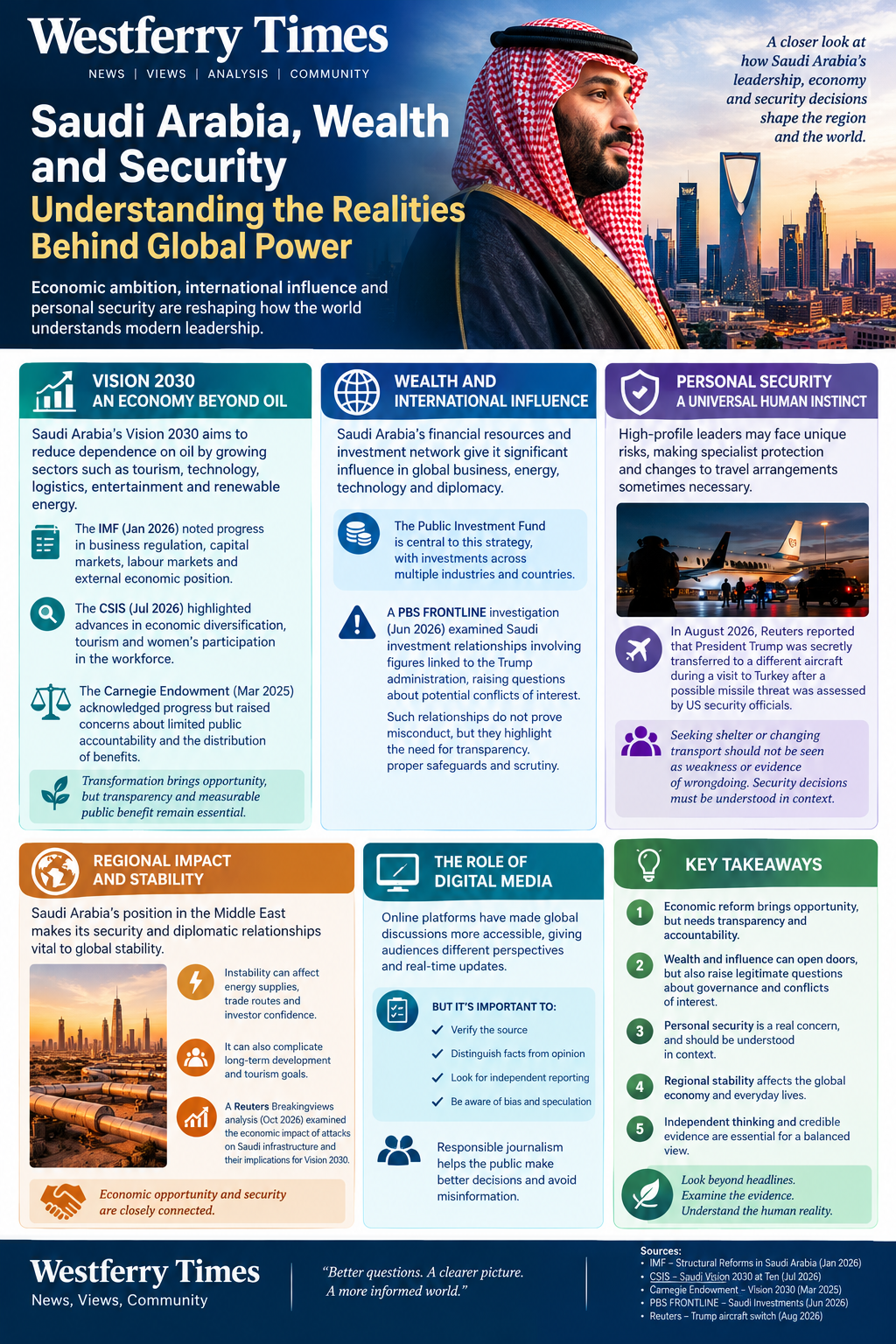
Economic ambition, international influence and personal security are reshaping how the world understands modern leadership.
In an increasingly uncertain world, the relationship between wealth, political influence and personal security has become an important subject for public discussion. Saudi Arabia offers a compelling case study: a country pursuing ambitious economic transformation while navigating regional tensions, international partnerships and continuing questions about governance and accountability.
Under Crown Prince and Prime Minister Mohammed bin Salman, commonly known as MBS, the Kingdom has embarked on a far-reaching programme of economic and social change. Its experience raises broader questions about how national wealth is used, how powerful leaders manage risk and how the international community should assess progress.
Vision 2030: An Economy Beyond Oil
Saudi Arabia’s Vision 2030 programme, launched in 2016, seeks to reduce the country’s dependence on oil by expanding tourism, technology, logistics, entertainment and other industries.
The International Monetary Fund’s January 2026 research on structural reforms identified improvements in business regulation, capital markets, labour markets and the country’s external economic position. Meanwhile, analysis published by the Center for Strategic and International Studies in July 2026 highlighted progress in economic diversification, tourism and women’s participation in the workforce. <Cite refs={[“turn139809search2″,”turn139809search1”]}/>
These developments matter well beyond the Gulf. Saudi Arabia’s investment decisions can influence international businesses, employment, infrastructure projects and emerging technology markets.
However, transformation on this scale also brings difficult questions. Are major investments delivering sustainable returns? Are the benefits reaching citizens across society? And how can large public projects be evaluated transparently?
A March 2025 assessment by the Carnegie Endowment for International Peace recognised progress under Vision 2030 while raising concerns about limited public accountability and the distribution of economic benefits. <Cite refs={[“turn139809search0”]}/>
A balanced assessment must consider both sides: the potential of economic reform and the importance of transparency, responsible spending and measurable public benefit.
How Wealth Shapes International Relationships
Modern international influence is not exercised through diplomacy and military strength alone. Investment funds, technology partnerships, energy markets and commercial relationships have become powerful instruments of global engagement.
Saudi Arabia’s Public Investment Fund is central to this strategy. Its investments connect the Kingdom with businesses and projects across multiple industries and countries.
A June 2026 PBS FRONTLINE investigation examined Saudi investment relationships involving figures associated with the Trump administration, including Jared Kushner and former Treasury Secretary Steven Mnuchin. The reporting raised questions about potential conflicts of interest and the relationship between private investment and public office. The existence of an investment relationship does not, by itself, establish improper conduct; such questions require careful examination of the circumstances, applicable rules and available evidence. <Cite refs={[“turn139809search3”]}/>
For the public, the underlying lesson is important: when substantial financial interests intersect with political relationships, transparency and appropriate safeguards help maintain confidence in institutions.
This principle applies equally to governments, corporations and private investors.
Personal Security: A Universal Human Instinct
Political leadership can involve risks that most people never experience. High-profile individuals may face threats to their safety, making confidential travel arrangements, specialist protection and changes to transport necessary in certain circumstances.
A notable example emerged in August 2026, when Reuters reported that President Donald Trump had been secretly transferred to a different aircraft during his departure from Turkey in July after US security officials assessed a potential missile threat. The operation was designed to conceal his movements, and Trump subsequently said he had followed the advice of the Secret Service. <Cite refs={[“turn139809news14″,”turn139809search6”]}/>
The incident illustrates a straightforward point: personal safety can take priority over public appearances, established routines and political optics.
Whether a person is a president, a business executive or an ordinary member of the public, the instinct to protect life is entirely understandable. Seeking shelter, changing a journey or following professional security advice should not automatically be interpreted as an admission of weakness or evidence of wrongdoing.
Nevertheless, security decisions can have wider implications. They may affect accompanying personnel, journalists, public resources and the flow of information. Responsible analysis therefore considers both the necessity of protection and the consequences of the decisions taken.
The same balanced approach should apply when discussing security arrangements involving leaders in Saudi Arabia or elsewhere. Claims about specific threats or incidents need reliable evidence; speculation should not be presented as fact.
Leadership in a Changing Region
Saudi Arabia’s position in the Middle East makes its security and diplomatic relationships important to the wider international community.
Regional instability can affect energy supplies, trade routes, investor confidence and the safety of civilians. It can also complicate ambitious development programmes that depend on international tourism, business partnerships and long-term investment.
A Reuters Breakingviews analysis published on 12 October 2026 examined the potential economic consequences of attacks affecting Saudi infrastructure and the implications for Vision 2030. Such developments underline how closely national security and economic planning can be connected. <Cite refs={[“turn139809news12”]}/>
For policymakers and businesses, resilience means preparing for uncertainty without abandoning long-term goals. For the public, it means understanding that economic opportunity and security are not separate issues: each can influence the success of the other.
The Importance of Independent Thinking
In the digital age, international affairs are increasingly discussed through online interviews, podcasts, social media and independent commentary. These channels can introduce audiences to different viewpoints and encourage questions that might otherwise receive limited attention.
But access to information is not the same as verification.
Readers should distinguish official statements from independent reporting, documented events from allegations, and evidence-based conclusions from personal opinion. Where accounts conflict, consulting multiple reputable sources can help establish what is known, what remains uncertain and what deserves further investigation.
This approach is particularly important when reporting on powerful individuals, where both uncritical praise and unsupported accusations can distort public understanding.
A More Balanced Understanding of Power
Saudi Arabia’s transformation demonstrates the complexity of modern leadership. Economic diversification can create opportunities, investment can strengthen international relationships, and effective security arrangements can protect lives. At the same time, major decisions involving public resources require transparency, sound governance and meaningful scrutiny.
These principles are not exclusive to any country or political system. They are relevant wherever wealth, authority and responsibility intersect.
The most useful question is therefore not whether a powerful individual should automatically be praised or criticised. It is whether decisions are supported by evidence, whether institutions act responsibly and whether the outcomes serve the wider public interest.
For readers of Westferry Times, the essential lesson is to look beyond headlines, examine reliable evidence and recognise that understanding global power requires both critical thinking and a fair appreciation of the human realities behind public life.
Editorial note: This article is an original analysis based on the sources cited. It does not imply that any unverified allegation is established fact.
Sources for the online edition
- International Monetary Fund — Structural Reforms in Saudi Arabia Since 2016
- Center for Strategic and International Studies — Saudi Vision 2030 at Ten
- Carnegie Endowment — Vision 2030 in the Home Stretch
- PBS FRONTLINE — How Mohammed bin Salman Has Wielded Saudi Arabia’s Wealth
- Reuters — Report on Trump’s aircraft switch amid a security threat

