




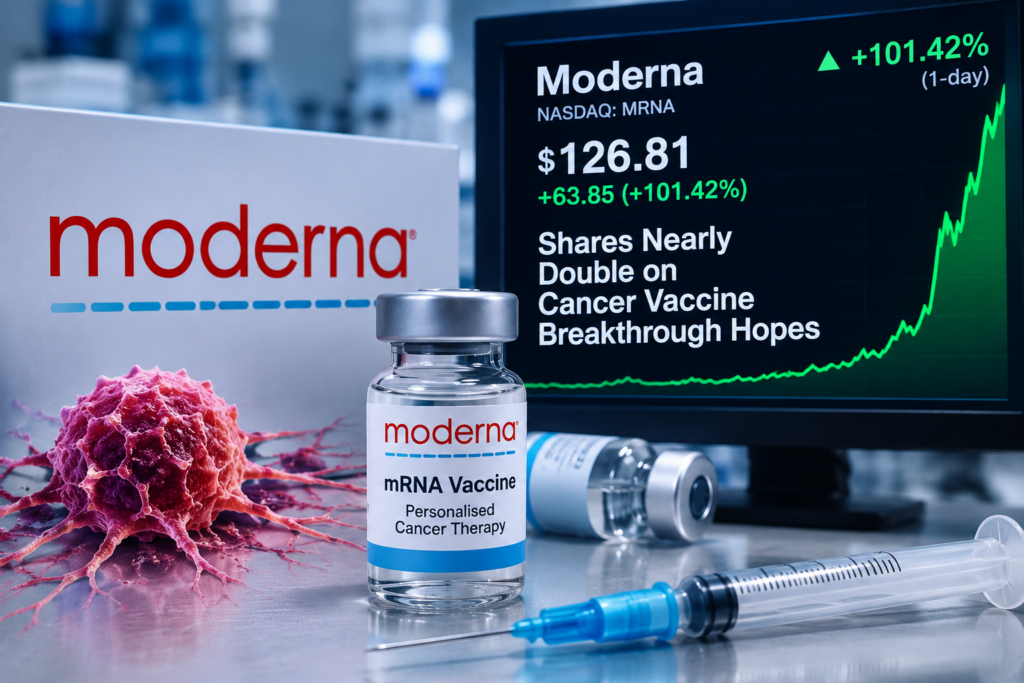
Shares in Moderna surged by almost 100% on Wednesday after a late-stage trial suggested the company’s experimental, personalised cancer vaccine could meaningfully reduce the return and spread of skin cancer.
The trial results
The treatment, called Intismeran, combines an immunotherapy drug developed by US pharmaceutical giant Merck with a Moderna mRNA vaccine — the same vaccine technology widely used against COVID-19. Unlike a standard vaccine, this version is made to order, tailored to the specific mutations found in each patient’s tumour.
In the late-stage trial, the vaccine-based treatment reduced the re-growth of skin cancer and stopped it spreading to other parts of the body. The study enrolled 1,137 high-risk patients with stage IIB-IV melanoma who had already had their tumours surgically removed. Participants were randomly assigned to receive either up to nine doses of Merck’s drug Keytruda combined with the personalised vaccine, or Keytruda alone, over roughly a year.
The result builds on earlier findings: in January, Merck and Moderna reported that a mid-stage trial showed the combination reduced the risk of recurrence or death by 49% after five years.
Market reaction
The news sent investors rushing into both stocks. When trading opened on the Nasdaq, Moderna’s share price jumped more than 84% to $115.91, before climbing further to $126.81 — more than double the previous day’s closing price of $62.96. Merck also rallied, rising over 8% to $146.50 at the open.
Analysts have previously estimated the commercial potential is significant. Barclays projected last month that the therapy could generate around $3bn a year from melanoma treatment alone by 2035.
A note of caution
Despite the market enthusiasm, some analysts urged restraint. Lale Akoner, global market strategist at eToro, said the results were a “major confidence boost” for investors and explained the scale of the share-price reaction, but cautioned that full trial data has not yet been released, overall survival results are still pending, and manufacturing personalised vaccines at scale could prove expensive and complex. She said investors should now watch for detailed clinical results, regulatory progress, and evidence the technology can work across other types of cancer.
Why it matters
Melanoma is the deadliest form of skin cancer. According to Cancer Research, around 2,600 people died from melanoma skin cancer in the UK between 2022 and 2024. A treatment that meaningfully cuts recurrence rates — particularly one personalised to a patient’s own tumour — would mark a significant step in the growing field of individualised cancer therapy.
Based on reporting by Sky News.

