



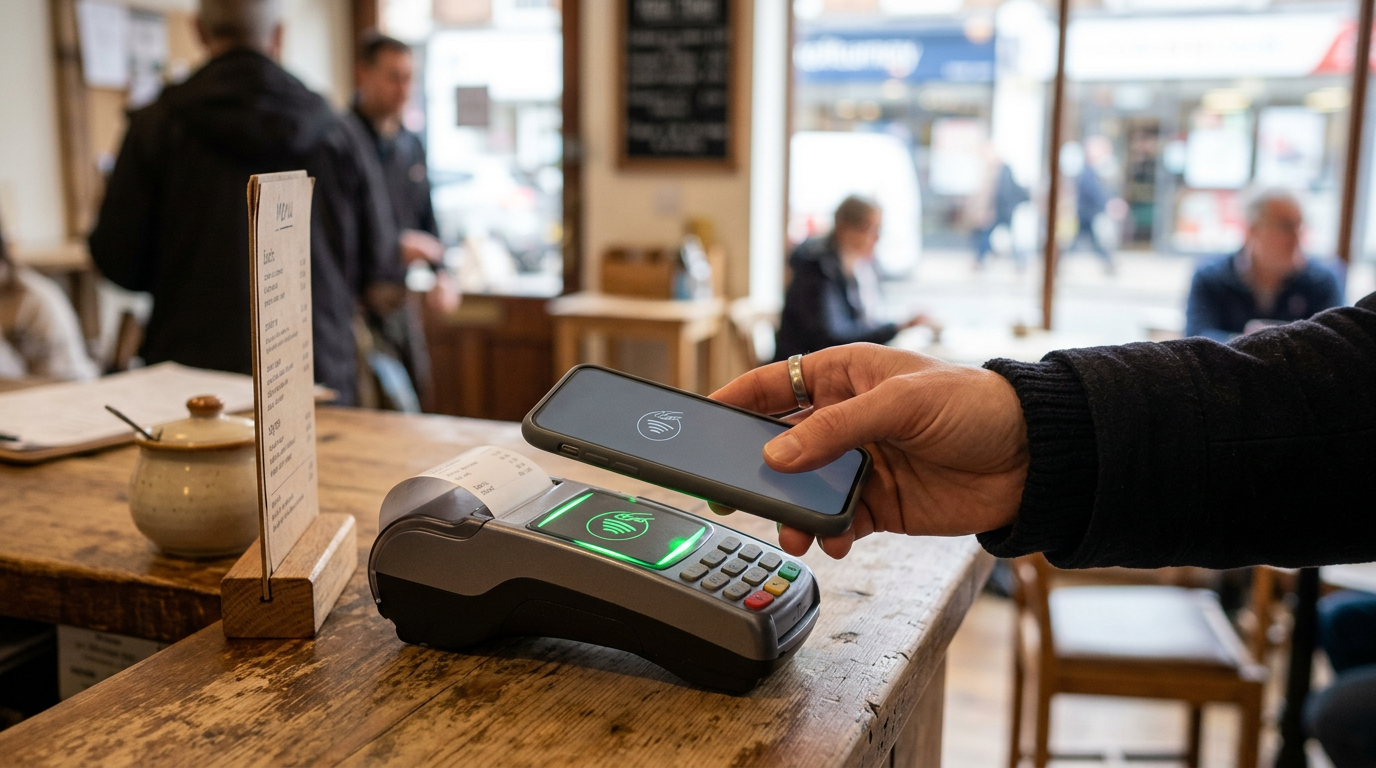

The UK competition watchdog has proposed forcing Apple to open up the iPhone contactless chip to rival payment apps on fairer terms and at substantially lower cost. The Competition and Markets Authority (CMA) launched a consultation on 20 October 2026 on a new rule for Apple’s mobile platform, saying the company’s fees, terms and technical limits on near field communication (NFC) may be holding back UK fintechs and other businesses. Apple says it already lets developers offer contactless services and has warned against changes it believes would weaken security.
What the CMA is proposing for iPhone contactless
NFC is the short-range wireless technology that lets a phone pay at a card terminal, open a hotel door or act as a train ticket. On iPhones, the main way to use it for payments is Apple Pay. The CMA’s proposed “conduct requirement” would oblige Apple to let developers use NFC on iOS on fair, reasonable, transparent and non-discriminatory terms.
In practice, the regulator wants two changes:
- Both main contactless standards. Apple would have to give access to the “secure element” (SE) approach it currently offers in the UK and also to host card emulation (HCE), which lets payment apps work without relying on the phone’s dedicated security chip. The CMA says neither standard raises inherent security concerns and that both are established technologies not developed by Apple.
- Lower fees. Rather than setting prices directly, the CMA would set principles for how access fees and terms are decided. It expects the result to be charges substantially lower than Apple’s current ones, while still fairly rewarding the company.
The proposal is made under the Digital Markets, Competition and Consumers Act 2024, which lets the CMA set tailored rules for firms it has designated as having “strategic market status”. Apple was previously given that status for its mobile platform.
Why the regulator says it matters
The CMA points to how central phone and card tapping has become. Citing UK Finance, it says contactless made up 39% of all UK payments in 2025, up from 3% a decade earlier, with 19.2 billion contactless transactions. Research by consumer group Which? found that 62% of UK adults use a digital wallet, with Apple Wallet the most popular at 50%.
Businesses told the regulator that Apple’s current arrangements may not be commercially viable, and that having to build different technical versions for different phone platforms makes it harder to grow. The CMA also contrasts the UK with the European Union, where Apple agreed to open NFC access for payments. Six months after that, the payments app Vipps launched the first alternative, followed by PayPal, Klarna, Curve and BBVA. By contrast, the CMA says no company has launched a competing wallet-style product in the UK.
More Read

Beyond payments, the regulator says easier access could support digital IDs and age checks, digital car, hotel and workplace keys, tickets and travel passes, and loyalty schemes.
Sarah Cardell, the CMA’s chief executive, said: “These proposals open the door to more innovation, more choice and economic growth”. She argued that removing barriers would particularly help the UK’s fintech sector. David Geale, managing director of the Payment Systems Regulator and an executive director at the Financial Conduct Authority, welcomed the plans, saying better access and lower fees should increase competition and support the growth of open banking.
How Apple has responded
Apple pushed back. According to ITV News and MacRumors, which cited a statement Apple gave to Reuters, the company said developers can already offer contactless transactions in their apps through its NFC and secure element platform, which it opened to UK developers in 2024. Apple said it does not believe the CMA should require it to adopt an approach with weaker privacy and security protections, and that it will continue to engage constructively with the regulator.
What happens next
The consultation runs until 11:59pm on 17 November 2026. The CMA will then weigh the responses before making a final decision. It has also said that non-disclosure agreements with Apple should not stop businesses from responding, and that Apple has confirmed it will not use other confidentiality terms to prevent submissions.
The move is the latest step in a wider programme of work on Apple’s and Google’s mobile platforms, following a call for evidence on iPhone NFC access in June. A think tank has previously argued that taking on Apple and Google could boost the UK economy. For consumers, the practical question is whether, as in the EU, banks and fintechs eventually offer tap-to-pay wallets on iPhone that sit alongside Apple Pay.
Sources: Competition and Markets Authority, CMA outlines proposals to unlock contactless technology on Apple iPhone (20 October 2026); Competition and Markets Authority, Proposed NFC access conduct requirement for Apple’s mobile platform (20 October 2026); Competition and Markets Authority, The CMA’s programme of work across mobile platforms (updated 20 October 2026); ITV News, Apple should open access to contactless payment systems, says regulator (20 October 2026); MacRumors, UK proposes new ways to help Apple Pay rivals (21 October 2026).

