



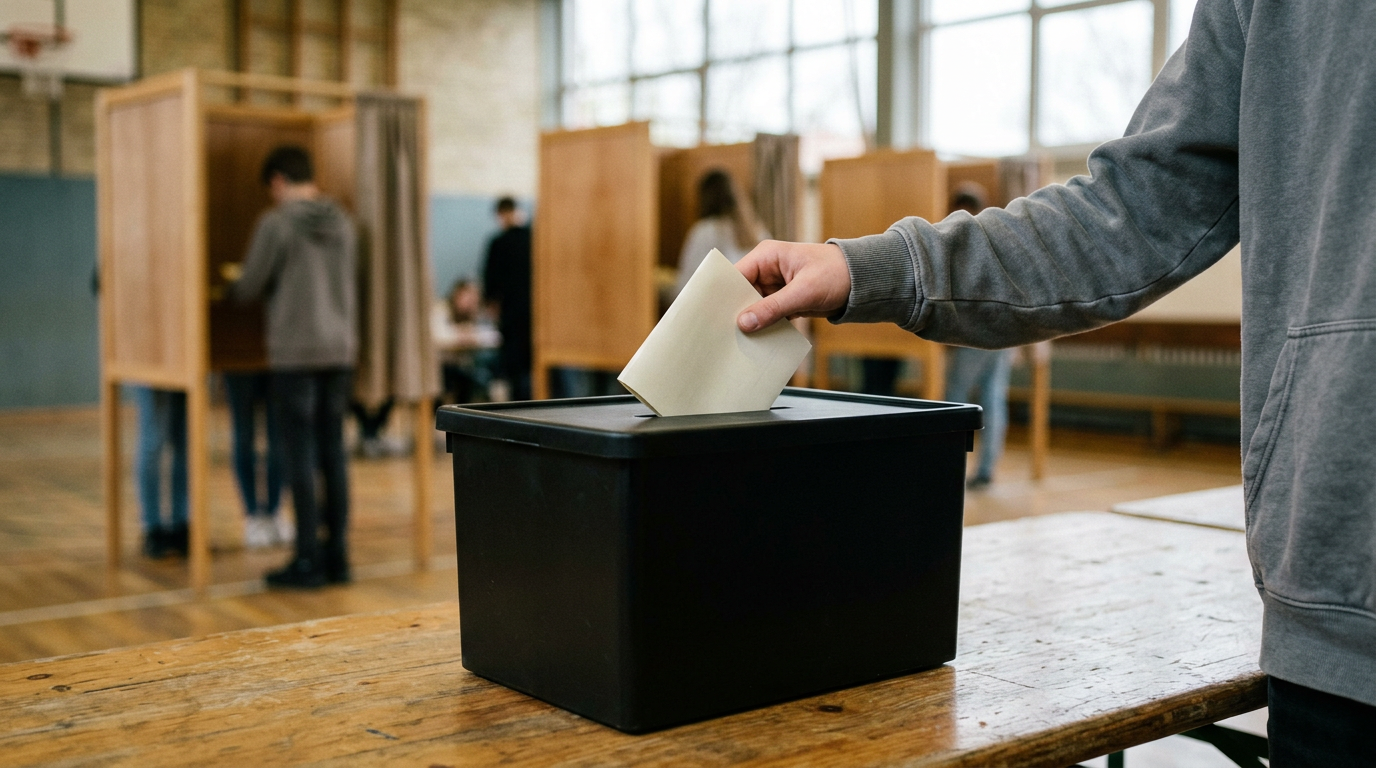

Will 16-year-olds be able to vote in UK general elections? Not yet. Votes at 16 is proposed in the government’s Representation of the People Bill, which would lower the voting age to 16 for all UK elections, including Westminster general elections. As of 29 October 2026 the bill has passed the House of Commons and is at committee stage in the House of Lords, so it has not become law. If it passes, 16- and 17-year-olds would have the same voting rights as adults, and young people could register from the age of 14.
This guide explains what the bill would change, where 16-year-olds can already vote, the arguments on each side, and what has to happen before the change takes effect.
Where can 16-year-olds vote now?
The voting age already varies across the UK, depending on which body runs the election. Sixteen- and 17-year-olds can currently vote in:
- Scottish Parliament elections and local council elections in Scotland
- Senedd (Welsh Parliament) elections and local council elections in Wales
They also voted in the 2014 Scottish independence referendum. For UK general elections, and for local elections in England and Northern Ireland, the minimum age is still 18. The bill is designed to remove that difference.
What the bill would change for votes at 16
The Representation of the People Bill was introduced in the House of Commons on 12 February 2026. According to the government’s policy summary on GOV.UK, published by the Ministry of Housing, Communities and Local Government, the bill would:
- Lower the voting age to 16 for all UK elections. Once registered, 16- and 17-year-olds would have the same rights as other voters.
- Allow registration from 14. Fourteen- and 15-year-olds could register in advance as “attainers”, so they are ready to vote if an election falls on or shortly after their 16th birthday.
- Protect younger voters’ data. Under-16s would not appear on any publicly available version of the electoral register and could not opt in to the open register.
- Carry over existing registrations. Under-18s already registered for devolved elections in Scotland and Wales could join the UK Parliament register when the change takes effect, without a separate application.
- Help looked-after children register. They could register in the area of the local authority responsible for their care.
The policy paper also sets out a change to political donations. Anyone on a UK electoral register can currently give money to a party, but registered 14- and 15-year-olds would not be allowed to, because their data is protected and their eligibility could not be checked. Sixteen- and 17-year-olds would keep the right to donate.
Alongside the bill, the government says it is working with the devolved governments and civil society on civic education. The Department for Education has committed to making citizenship compulsory in primary schools.
What else is in the Representation of the People Bill?
Votes at 16 is the headline measure, but the bill is a wider package of election reforms. The House of Commons Library and a summary by The Lawyer Portal describe proposals including:
Voter ID
UK-issued bank cards showing the voter’s name would be accepted as voter ID at polling stations, and digital forms of government ID would be allowed, with safeguards against screenshots. Research by the Ministry of Housing, Communities and Local Government suggested that adding bank cards would cut the share of people without accepted ID from 2–4% to under 1%. The Electoral Commission welcomed the changes but warned that bank cards carry risks for security and voter trust. Our earlier report on ministers’ pledge to improve the voter ID law covers the background.
Registration
The bill aims to move towards more automatic registration through better data sharing between public bodies, with pilots first. The Electoral Commission has estimated that around 8 million people may be missing from the electoral register.
More Read

Donations and enforcement
Company donors would need a genuine UK connection and UK-generated income, and parties would face tighter checks on where money comes from. The Commons Library reports that the Electoral Commission’s maximum fine would rise from £20,000 to £500,000, with stronger enforcement powers over candidate and local campaign finance.
Postal votes and candidate safety
The deadline to apply for a postal vote would move from 11 to 14 working days before polling day. Candidates would no longer have to publish their home addresses, and intimidation of candidates and election staff would be treated as an aggravating factor in sentencing.
The arguments for and against votes at 16
Lowering the voting age was a Labour manifesto commitment in 2024, and it has support from several other parties in the Commons. Supporters point to Scotland and Wales, where 16- and 17-year-olds already vote in devolved elections. The Commons Library notes that research has found no effect on election results where the voting age has been lowered.
Opponents include the Conservatives, the Democratic Unionist Party and Reform UK. According to the Commons Library, Conservative MP Paul Holmes questioned whether 16-year-olds should be able to vote. The Lawyer Portal lists Reform UK leader Nigel Farage among the opponents and reports that one concern among them is that younger voters tend to favour left-of-centre parties.
How young people get their political information is part of the wider debate. A survey we reported on found that almost half of young people trust social media about politics.
When could 16-year-olds first vote in a general election?
Nothing changes until the bill completes its passage through both Houses of Parliament and receives Royal Assent, and the government then brings the new rules into force. The government’s aim, according to the Commons Library, is to have votes at 16 in place for the next general election, which must be held by 15 August 2029.
The bill has already crossed one session of Parliament. It had not passed when Parliament was prorogued at the end of April 2026, so the government used a carry-over motion to let it continue after the King’s Speech of 13 May 2026, as Full Fact’s government tracker records. MPs then completed its Commons stages on 2 September 2026, when they voted for it at third reading, according to the division record on TheyWorkForYou. The bill received its first reading in the House of Lords on 3 September, as the UK Parliament bills website shows.
As of 29 October 2026, the bill was at committee stage in the House of Lords and had not become law. A Scottish Parliament committee report published on 13 October described it as being at that stage. The parliamentary tracker Westminster Brief records a Lords second reading on 14 September and lists committee stage as due to begin on 2 November 2026. After that, the bill still faces report stage and third reading in the Lords, followed by consideration of any amendments, before it can receive Royal Assent. Full Fact’s tracker, in its update of 24 September 2026, rated the pledge as appearing on track.
Frequently asked questions
Can 16-year-olds vote in the UK?
Yes, but only in some elections. They can vote in Scottish Parliament and Senedd elections and in council elections in Scotland and Wales. As of October 2026, they cannot vote in UK general elections or in local elections in England and Northern Ireland.
Has votes at 16 become law?
Not as of 29 October 2026. The Representation of the People Bill, introduced on 12 February 2026, has passed the Commons and is at committee stage in the House of Lords.
Will 14-year-olds be able to vote?
No. Under the bill, 14- and 15-year-olds could register in advance, but they could not vote until they turn 16. Their details would be kept off public versions of the register.
Which parties oppose votes at 16?
The Conservatives, the DUP and Reform UK have opposed or questioned the change. Labour proposed it, and other parties in the Commons support it.
Sources: GOV.UK (MHCLG), Votes at 16 policy summary (first published 12 February 2026); House of Commons Library, The next elections bill (accessed 28 October 2026); Full Fact, Government tracker: votes for 16 and 17-year-olds (updated 24 September 2026); The Lawyer Portal, A summary of the Representation of the People Bill (2 July 2026); UK Parliament, Representation of the People Bill: publications (accessed 29 October 2026); TheyWorkForYou Votes, Representation of the People Bill: Third Reading (2 September 2026); Scottish Parliament Delegated Powers and Law Reform Committee, report on the Representation of the People Bill (13 October 2026); Westminster Brief, Representation of the People Bill (accessed 29 October 2026).

