



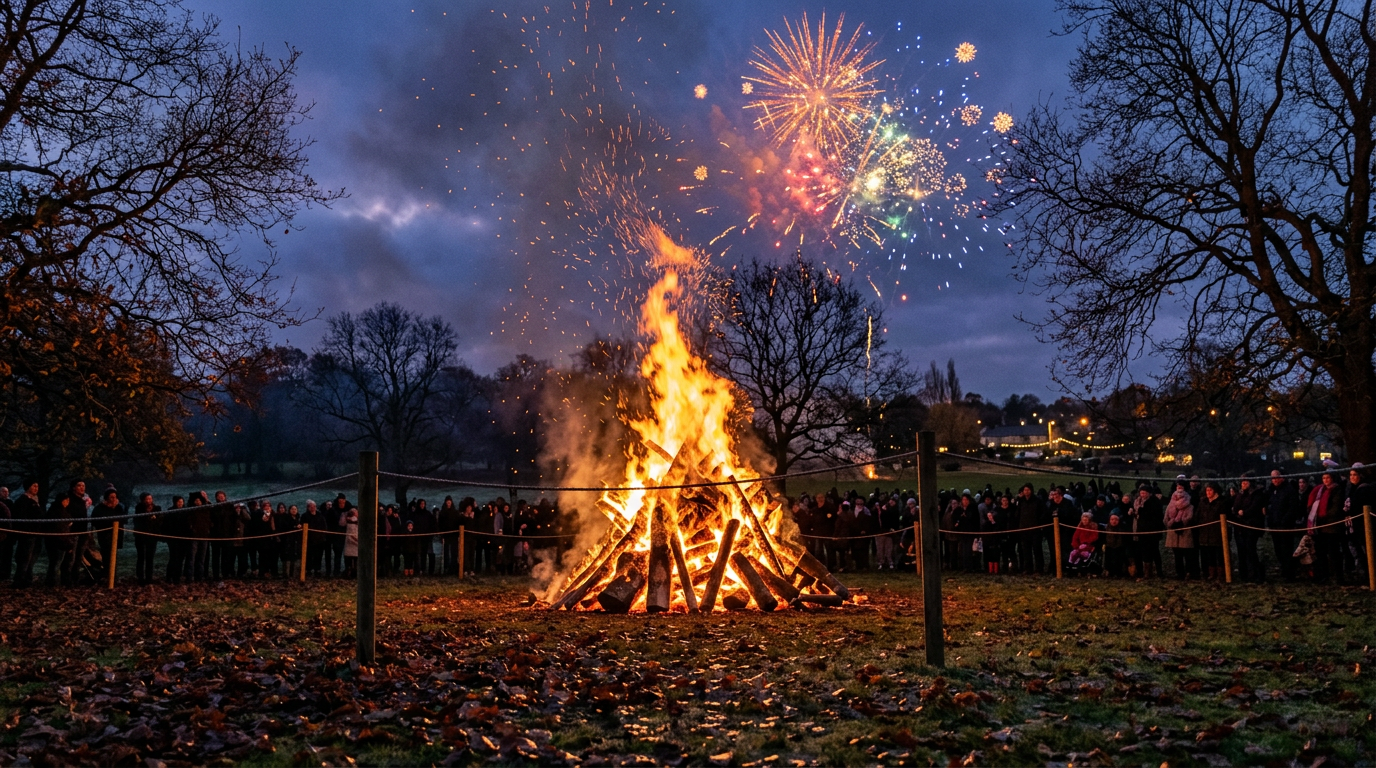

The history of Bonfire Night goes back to the night of 4–5 November 1605, when guards found Guy Fawkes in a storeroom beneath the House of Lords with barrels of gunpowder, foiling a Catholic plot to blow up Parliament and kill King James I. Within months, Parliament ordered that the King’s escape be marked with thanksgiving every year, and the bonfires, fireworks and burning “guys” that fill British skies each November grew out of that official celebration.
More than four centuries later, 5 November is still one of the few dates in the British calendar tied to a single political event. Here is what actually happened in 1605, how a state-ordered day of thanksgiving became a night of fireworks, and how the plot is still remembered at Westminster today.
What was the Gunpowder Plot?
The Gunpowder Plot was a conspiracy to destroy the House of Lords during the State Opening of Parliament in November 1605, killing the Protestant King James I and much of the political establishment in one blast. Its organiser was Robert Catesby, a committed Catholic, not Guy Fawkes, who is remembered far more widely.
According to Royal Museums Greenwich, English Catholics had hoped James would be more tolerant than Elizabeth I. His wife, Anne of Denmark, was Catholic, and he had seemed sympathetic at first. Those hopes collapsed in early 1604, when James told Parliament of his hostility to the Catholic faith and, days later, ordered Jesuit and Catholic priests to leave the country.
Catesby’s answer was violent. With the King dead, the plotters intended to place his nine-year-old daughter, Princess Elizabeth, on the throne as a figurehead for a Catholic-led government.
Who were the conspirators?
UK Parliament names five central plotters: Robert Catesby, Thomas Wintour (often spelt Winter), John Wright, Thomas Percy and Guy Fawkes. English Heritage says the five met at the Dog and Duck pub in London on 20 May 1604, the date on which they swore an oath of secrecy. Eight more men joined later, including Robert Keyes, Robert Wintour, Christopher Wright, Ambrose Rookwood, Francis Tresham and Sir Everard Digby.
Fawkes, a soldier with experience of explosives, was chosen to guard the gunpowder and light the fuse. Parliament’s own guidance describes him as a minor figure who is often wrongly remembered as the leader.
The cellar and the 36 barrels
Royal Museums Greenwich says the group first considered tunnelling under Parliament, then in 1605 rented a cellar directly beneath the House of Lords. Thomas Percy took the lease, and Fawkes posed as his servant under the name “John Johnson”. Gunpowder was not hard to obtain after years of war with Spain, and the plotters stockpiled 36 barrels, hidden under firewood.
How the plot was discovered
The conspiracy unravelled through an anonymous letter. Dated 26 October 1605, it warned Lord Monteagle, a Catholic peer and the brother-in-law of plotter Francis Tresham, to stay away from the opening of Parliament. Monteagle took it to the King’s chief minister, Robert Cecil, Earl of Salisbury. Cecil waited until James returned from hunting and showed him the letter on 1 November.
The plotters learned that the letter existed but decided to carry on. On 4 November, a search of the vaults under Parliament found a large pile of firewood and a man calling himself John Johnson, who said it belonged to his master, Percy. A second search around midnight found Fawkes again, dressed for a quick getaway and carrying fuses and matches. He was arrested, and the gunpowder was discovered.
Historians still debate how genuine the Monteagle letter was. UK Parliament notes that the traditional account sees the plot as a Catholic attempt to restore their faith, while some later historians have suspected agents provocateurs, keen to discredit the Jesuits and strengthen Protestant control.
What happened to Guy Fawkes and the plotters?
Fawkes was taken to the Tower of London and tortured until he named his fellow conspirators. Most of the others had fled to the Midlands. On 8 November 1605 they made a last stand against around 200 men in Staffordshire, where Catesby, Percy and the two Wright brothers were killed.
The eight surviving plotters were tried for high treason on 27 January 1606 and sentenced to be hanged, drawn and quartered. Four, including Digby, were executed in St Paul’s Churchyard on 30 January. The next day, Fawkes, Thomas Wintour, Rookwood and Keyes were executed at Old Palace Yard in Westminster, yards from the building they had planned to destroy.
More Read

How Bonfire Night began: from thanksgiving to fireworks
Bonfire Night did not start as folk custom. In January 1606, Parliament passed an Act requiring every church in England to hold a service of thanksgiving on 5 November each year, and attendance was compulsory. The law stayed in force until 1859, according to UK Parliament.
Alongside the sermons, people marked the day with their own celebrations. English Heritage lists bonfires, bell ringing, artillery salutes and fireworks among the ways the King’s survival was celebrated. Over the following two centuries the tradition changed in several stages:
- Anti-Catholic ritual: the church services were often strongly anti-Catholic in tone. From 1673 into the 19th century, crowds paraded and burned effigies of the Pope.
- Fawkes becomes the villain: after the French Revolution, when English and Irish Catholics fought on Britain’s side, Guy Fawkes replaced the Pope as the figure on the bonfire.
- A family occasion: in the 20th century the night became a family event. Children wheeled home-made “guys” through the streets asking passers-by for money before the effigies went on the fire.
- Fireworks take centre stage: today the focus is on bonfires and displays. As English Heritage points out, the gunpowder that sends fireworks into the sky is the same substance the plotters meant to use.
The day has gone by several names: Guy Fawkes Night, Bonfire Night and Firework Night are all common, and Parliament’s guidance uses all three. If you are curious about how other autumn customs evolved, our explainer on the history of Halloween traces a very different set of roots.
How the Gunpowder Plot is still remembered at Westminster
The most visible link to 1605 is a ceremony few people see. Before the monarch arrives for the State Opening of Parliament, the Yeomen of the Guard, the sovereign’s ceremonial bodyguard, search the cellars of the Palace of Westminster. UK Parliament describes the search as a picturesque custom rather than a genuine security measure, since modern counter-terrorism work is handled very differently.
The cellar itself no longer exists. It was destroyed in the fire of 1834 that burned down most of the medieval Houses of Parliament. One object from that night does survive: the lantern Fawkes is said to have carried is held at the Ashmolean Museum in Oxford. For the plot’s 400th anniversary in 2005, an exhibition was staged in Westminster Hall.
Bonfire Night today: dates, displays and the fireworks curfew
In 2026, 5 November falls on a Thursday, so many organised displays are being held on the nearest weekend. Leicester City Council, for example, is running its main bonfire and fireworks event at Abbey Park on Saturday 7 November, with advance tickets only.
For anyone planning a private display, the law sets clear limits. Under the Fireworks Regulations 2004, adult fireworks must not be used between 11pm and 7am. Bonfire Night is one of four exceptions:
- 5 November: fireworks allowed until midnight.
- Diwali: allowed until 1am the following morning.
- New Year’s Eve: allowed until 1am on 1 January.
- The first day of Chinese New Year: allowed until 1am the following morning.
Council displays and national celebrations or commemorative events are also exempt. Scotland and Northern Ireland set some fireworks rules separately, so readers there should check local guidance.
Why the history of Bonfire Night still matters
For most families, Bonfire Night is now about sparklers, toffee apples and a display in the local park. But its origins are a reminder of how sharply religion divided early modern England, and of how a government shaped public memory: the thanksgiving was ordered by law, enforced in every parish, and kept on the statute book for more than 250 years. The fact that the night survived long after its official purpose faded says a good deal about how traditions are made, and remade, over time.
Frequently asked questions
Why do we celebrate Bonfire Night on 5 November?
Because the Gunpowder Plot was foiled in the early hours of 5 November 1605. Parliament made the date an annual day of thanksgiving in 1606, and bonfires and fireworks became part of the celebrations.
Was Guy Fawkes the leader of the Gunpowder Plot?
No. Robert Catesby organised the conspiracy. Fawkes was responsible for guarding and igniting the gunpowder, and became famous because he was the one caught with it.
How many barrels of gunpowder were found?
Thirty-six barrels were found in the cellar beneath the House of Lords, according to English Heritage and Royal Museums Greenwich.
Is Parliament still searched because of the Gunpowder Plot?
Yes, ceremonially. The Yeomen of the Guard search the cellars of the Palace of Westminster before every State Opening of Parliament, a tradition that dates back to the plot.
Was it ever a legal requirement to mark 5 November?
Yes. An Act passed in 1606 required a church service of thanksgiving every 5 November. It remained law until 1859.
Sources: Royal Museums Greenwich, What was the Gunpowder Plot? (accessed October 2026); UK Parliament, Frequently Asked Questions: The Gunpowder Plot (accessed October 2026); UK Parliament, State Opening: elements unseen by the public (accessed October 2026); English Heritage, What is Bonfire Night? (accessed October 2026); legislation.gov.uk, The Fireworks Regulations 2004, regulation 7 (2004); Leicester City Council, Get your tickets for Leicester’s biggest bonfire night celebration (13 October 2026).

