



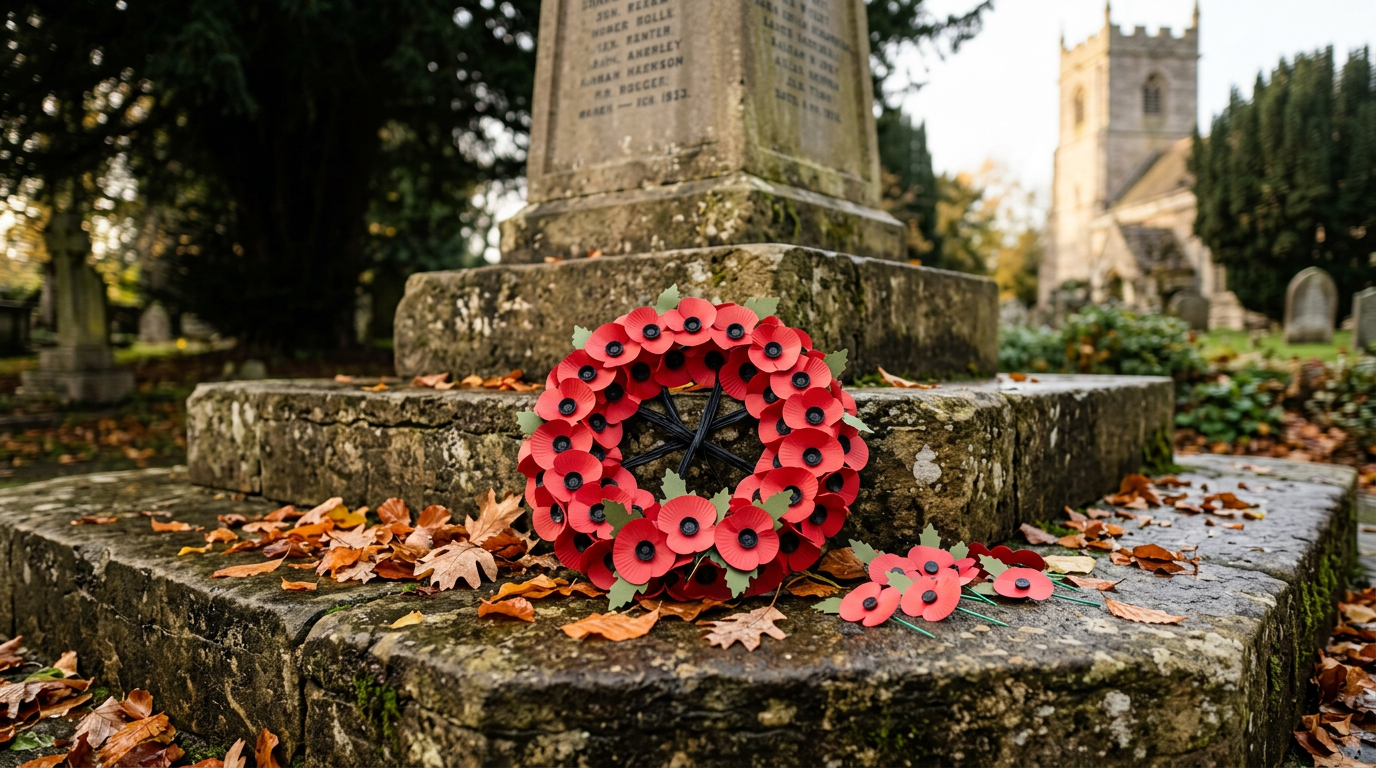

Why do we wear poppies? Because red poppies flourished on the shattered battlefields of the First World War, and after a Canadian army doctor wrote about them in 1915 they became the symbol of the war dead. Britain’s first Poppy Day was held on 11 November 1921, and the paper poppy has been worn every autumn since. In 2026, Remembrance Sunday falls on 8 November and Armistice Day on Wednesday 11 November.
This guide explains where the remembrance poppy came from, what the different colours mean, how Remembrance Sunday differs from Armistice Day, and what is happening in 2026.
Why do we wear poppies? The First World War origins
The link between poppies and war began on the Western Front. According to Imperial War Museums (IWM), constant artillery fire churned up the soil of Flanders and northern France, and the disturbed ground suited the common red poppy, which flourished among the craters. Soldiers saw the flowers everywhere, and some pressed the petals into letters they sent home.
John McCrae and In Flanders Fields
In May 1915, Lieutenant Colonel John McCrae, a Canadian doctor working at a dressing station near Ypres, wrote a short poem set in a war cemetery and spoken in the voice of the dead. IWM notes that The Spectator turned it down and that the poem was first published in Punch. It became one of the best-known poems of the war. McCrae himself did not survive the conflict.
Moina Michael and Anna Guérin
Two women turned the poem’s imagery into a movement. In 1918, just before the armistice, the American humanitarian Moina Michael wrote a poem in response and began buying artificial poppies to hand out as lapel badges, campaigning for the flower to be adopted as a symbol of remembrance.
In France, Anna Guérin, known as “the poppy lady from France”, organised war widows to make silk poppies to raise money. By 1920 American veterans’ organisations had adopted the poppy, and in August 1921 Guérin travelled to Britain to persuade the British Legion to sell them.
The first Poppy Day and the Poppy Appeal
Britain’s first Poppy Day took place on 11 November 1921, with the money going to the Earl Haig Fund to support ex-servicemen and the families of those who had died. IWM says demand was so high that sellers ran out, and it estimates the total raised at around £3 million in today’s money.
In 1922 the British Legion set up its own factory, staffed by disabled former servicemen, which still makes poppies today. A second factory was later established in Edinburgh, which is why poppies sold in Scotland look different: they have four petals and no green leaf.
The fundraising campaign that grew from that first Poppy Day is now the Royal British Legion’s Poppy Appeal. The charity says the 2025 appeal raised £56.6 million and that around 60,000 collectors and volunteers take part each year. The money pays for support for serving personnel, veterans and their families, from help with financial hardship and bereavement to care in later life.
Before the poppy: remembrance in 1920
The poppy was not part of the earliest national acts of remembrance. IWM points out that 1920 saw the two-minute silence, the burial of the Unknown Warrior and the unveiling of the Cenotaph in Whitehall, yet photographs of the Cenotaph ceremony show wreaths made of other flowers. The poppy only became established after the 1921 appeal.
More Read

What do the different poppy colours mean?
The red poppy is the best known, but it is not the only one:
- Red: commemorates those who died in the First World War and later conflicts. Writing for IWM, historian Laura Clouting describes it as a symbol of hope as well as loss.
- White: dating from the 1930s and sold today by the Peace Pledge Union, it was created to promote peace and challenge militarism. Some people wear it alongside the red poppy.
- Purple: remembers animals killed in conflict.
The poppy is not without debate. IWM acknowledges that some people find it contentious, pointing to its use by far-right groups and its association with British military actions, including in Northern Ireland during the Troubles. Whether to wear one remains a personal choice.
Remembrance Sunday and Armistice Day: what is the difference?
The two dates are often confused, but they mark different things:
- Armistice Day is always 11 November. A two-minute silence has been held at 11am on that date since 1919, marking the hour the fighting of the First World War stopped in 1918.
- Remembrance Sunday is the second Sunday in November. It is the main national day of commemoration, when services and parades are held at war memorials across the UK.
Remembrance today covers far more than the First World War. The government describes the national service as honouring British and Commonwealth servicemen and women and civilians who served in the two world wars and later conflicts. The 80th anniversary commemorations of VE Day in 2025, which we covered in stories such as a Yorkshire care home’s celebration, showed how strongly those memories still run in communities.
Remembrance Sunday 2026: date and key events
As of October 2026, these are the main national dates published by the Royal British Legion and the government:
- 22 October: national launch of the Poppy Appeal, with poppies available in shops, stations and online.
- 29 October: London Poppy Day.
- Saturday 7 November: Festival of Remembrance at the Royal Albert Hall.
- Sunday 8 November: National Service of Remembrance at the Cenotaph, Whitehall, starting at 11am.
- Wednesday 11 November: Armistice Day, with a two-minute silence at 11am.
Attending the Cenotaph service
Guidance from the Department for Culture, Media and Sport says the two-minute silence at 11am will be marked by guns fired by the King’s Troop on Horse Guards Parade. Royal British Legion detachments begin to file onto Whitehall from 10.50am and march past the Cenotaph once the service ends at about 11.25am. “No tickets or passes are needed for the event,” the guidance says, and Whitehall opens to the public at 8am, although access may be restricted once the area is full. Visitors are asked not to take photographs during the silence, and the service is broadcast on the BBC, Sky and ITV.
Local services
Most towns and cities hold their own services on Remembrance Sunday. In Leicester, for example, the city council says the parade and service will take place at the Arch of Remembrance in Victoria Park on 8 November, with the Last Post and a two-minute silence at 11am, and a further silence at Leicester Market on 11 November. Check your council or local Royal British Legion branch for times near you.
How the poppy is remembered today
The poppy’s power as a symbol was shown most vividly in 2014, when the installation Blood Swept Lands and Seas of Red, by Paul Cummins and Tom Piper, filled the moat of the Tower of London with 800,000 ceramic poppies. IWM says parts of it later toured 19 locations around the UK and were seen by nearly 10 million people. More than a century after Flanders, the small red flower remains the most widely recognised sign of remembrance in Britain.
Frequently asked questions
When is Remembrance Sunday 2026?
Sunday 8 November 2026. The National Service of Remembrance at the Cenotaph begins at 11am.
Why are Scottish poppies different?
Poppies sold in Scotland are made at a separate factory in Edinburgh. They have four petals and no green leaf, unlike the design with a leaf sold elsewhere in the UK.
When was the first Poppy Appeal?
The first Poppy Day in Britain was held on 11 November 1921. The Royal British Legion’s Poppy Appeal has run every year since.
What does a white poppy mean?
White poppies, sold by the Peace Pledge Union, date from the 1930s and were created to promote peace and challenge militarism.
Do you need a ticket for the Cenotaph service?
No. Government guidance says no tickets or passes are needed. Whitehall opens to the public at 8am on Remembrance Sunday, but space is limited and entry may be restricted once the area is full.
Sources: Imperial War Museums, Why we wear poppies on Remembrance Day (accessed October 2026); Royal British Legion, The Poppy Appeal (accessed October 2026); DCMS and Ministry of Defence, National Service of Remembrance: Sunday 8 November 2026 (updated 20 October 2026); Royal British Legion Mansfield Branch, Remembrance (accessed October 2026); Leicester City Council, City to fall silent for Remembrance Sunday commemorations (27 October 2026).

