



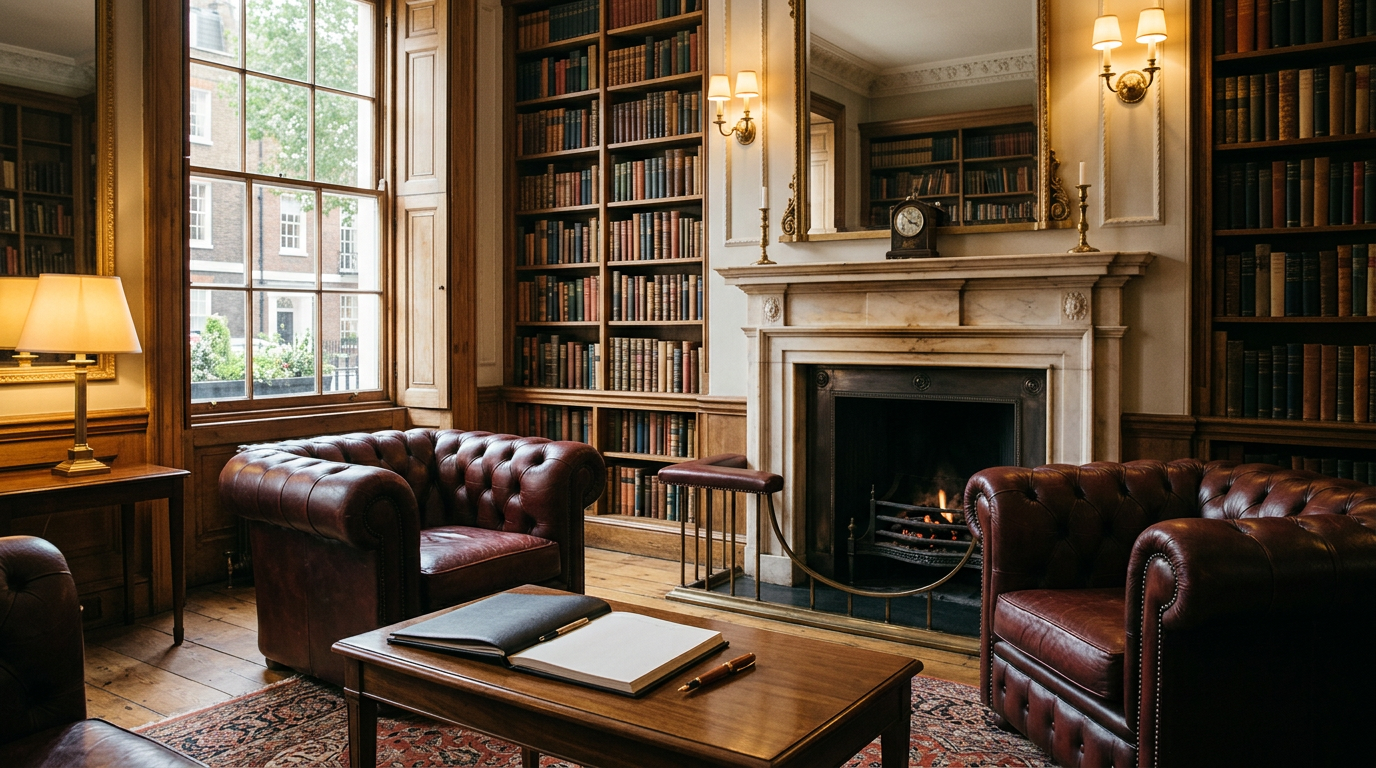

How do private members’ clubs work? In short, a club limits access to people it has accepted as members. You apply, sometimes with the backing of existing members, a committee decides, and if you are admitted you pay a one-off joining fee and an annual subscription. In return you can use the club’s rooms, restaurants and events, bring a limited number of guests, and agree to follow its house rules. The details vary a great deal from one club to the next, so this guide explains the main steps and what to check before you apply.
What is a private members’ club?
A private members’ club is a venue that only members and their guests can use. It might be a Georgian townhouse, a few floors of a hotel or a converted warehouse. Most have bars, restaurants, lounges and meeting rooms, and the larger ones add bedrooms, gyms, spas, screening rooms or co-working space.
The idea is an old one. Writing in City AM in December 2025, Daniel Kyriakides, a real estate partner at the law firm Reed Smith, noted that today’s clubs trace their origins to the gentlemen’s clubs of St James’s in the 18th and 19th centuries. What has changed is the variety. London now has:
- Traditional clubs, many on or around Pall Mall, where candidates are nominated by members and dress codes are strict.
- Social and creative clubs, such as Soho House, which sells access either to one local House or to its whole international network.
- Family clubs, such as OurHouse, which combines childcare, play areas, gyms and co-working space and won planning approval for two more London sites in 2026.
- Purpose-led clubs, such as The Conduit in Covent Garden, which says it looks for members working to create positive change.
- Hotel clubs, where a hotel runs a members’ area alongside its rooms. Kyriakides described this hybrid model as one of the forces reshaping hotel investment in London.
Clubs also compete with the wider night-time economy, which has changed sharply in recent years. As Westferry Times has reported, some operators say younger people are going out less often than they used to.
How do private members’ clubs work when you apply?
Most clubs follow the same broad sequence: an application, some form of vetting, a decision and then payment. How formal each step is depends largely on the club’s age and style.
Step 1: the application
Newer clubs usually take applications online. Soho House says its form takes about a quarter of an hour, and it asks for a recent profile photograph, card details and information about your interests and occupation. The House of KOKO in Camden says anyone is welcome to apply. Many clubs care as much about what an applicant would add to the community as about what they earn. The Conduit, for example, asks applicants to explain what matters to them and what change they are working towards.
Step 2: proposers, seconders and references
Traditional clubs depend on existing members to vouch for newcomers. When the Garrick Club voted in May 2024 to admit women, NPR described how its process works: a current member nominates the candidate, the candidate dines at the club with members, and a committee then discusses the nomination. The whole process can take years. At Annabel’s in Mayfair, Spear’s reported in 2023 that applicants needed a letter of recommendation from a member of one of the Birley clubs, saying how long the member had known them.
Step 3: the committee and the waiting list
Membership committees decide who gets in, and popular clubs cap their numbers. City AM reported in July 2026 that the Royal Automobile Club limits itself to 17,000 paid-up members and that its waiting list had grown to more than 1,200 applicants. Some clubs also have their own routes in. The Athenaeum’s committee can invite a small number of particularly eminent people each year under its “Rule II”, bypassing the queue, a tradition dating from 1830.
Step 4: paying the fees
Once accepted, you normally pay two charges: a one-off joining fee and an annual subscription. Many clubs offer cheaper tiers for younger members. The Sloane Club’s Under 35 rate is for applicants aged 21 to 34, who move to a standard category at their first renewal after turning 35. The House of KOKO splits its prices at 35, and Soho House offers special pricing to members who join under 27, which lasts until their 30th birthday. Some clubs let you pay monthly or offer joint memberships for couples. Prices vary widely, so check the club’s own website before applying.

What membership usually includes
The subscription buys you access, not unlimited hospitality. Food, drink and bedrooms are paid for on top. Kyriakides noted that clubs earn money from restaurants and bars, wellness, events, co-working and private hire as well as from fees. Beyond that, the main benefits are:
- Which sites you can use. Soho House sells an Every House membership covering more than 48 Houses, a Local House membership for the House nearest your home, and a Cities Without Houses option for people living where it has no club.
- Guests. Most clubs limit how many people you can bring. Soho House’s Every House members can bring up to three, and its January 2026 update said this would rise to five on a member’s birthday from April.
- Reciprocal clubs. Some clubs have arrangements with clubs elsewhere. The Sloane Club says its members can use more than 120 reciprocal clubs around the world.
- Extras. Depending on the tier, these can include gyms, pools, screening rooms, events programmes and member rates on bedrooms.
House rules, dress codes and etiquette
Clubs publish house rules, and members are generally responsible for making sure their guests follow them too. Three areas come up again and again.
Phones and laptops
At the Royal Automobile Club’s Pall Mall clubhouse, phones may be used on silent in most areas, but calls are allowed only in phone booths, designated business areas, pre-booked meeting rooms or bedrooms. Laptops are limited to the business centre, the library, booked rooms and bedrooms. Soho House Berlin’s published guidelines are similar: phone and video calls are not allowed in the club, essential calls go to set areas, and laptops are restricted to certain floors and hours.
Dress codes
Traditional clubs tend to be the strictest. The Royal Automobile Club sets standard, smart and sports dress codes for different parts of its Pall Mall building. Denim is not allowed in the clubhouse except when passing between the entrance, changing rooms and bedrooms, and sports trainers are for the sports and spa areas only. The club relaxes some of these rules in certain rooms for limited periods, as it did in late October 2026. Codes differ a great deal from club to club, so read them before your first visit.
Children and discretion
Rules on children differ. At the Royal Automobile Club, the adult dress codes apply to anyone aged seven or over. At Soho House Berlin, under-18s count towards a member’s guest allowance unless they hold a child membership, and they can stay in the House until 7pm. Beyond the written rules, the common thread is discretion. Clubs sell privacy, and members are expected to respect it.
Questions to ask before you apply
- How often will you realistically go, and is the club near where you live or work?
- What does your tier include: guests, bedrooms, the gym, other sites or reciprocal clubs?
- What are the joining fee and annual subscription, and will your rate rise when you leave a younger age band?
- Do the house rules on phones, laptops and dress suit the way you want to use the club?
- Does the club’s focus, whether creative, business, family or social, match what you are looking for?
Frequently asked questions
Do you need to know a member to join?
It depends on the club. Traditional clubs usually need a current member to nominate or recommend you, while many newer clubs take applications directly online and review them through a committee.
Can non-members visit a private members’ club?
Usually only as a member’s guest, and clubs limit how many guests each member can bring. Soho House’s Every House membership, for example, allows up to three.
How long does it take to join?
It varies widely. Online applications are usually quicker, while clubs with nomination systems or long waiting lists, such as the Garrick or the Royal Automobile Club, can take years.
Do all private members’ clubs admit women?
Many do, but not all. The Reform Club changed its rules in 1981 to admit women on equal terms, the Athenaeum followed in 2001 and the Garrick voted to do so in 2024. White’s in St James’s still has an all-male membership.
Sources: Soho House, Membership (accessed October 2026); Soho House, Your new Every House member benefits (30 January 2026); Soho House, Soho House Berlin house guidelines (accessed October 2026); Royal Automobile Club, Pall Mall dress code and standards (accessed October 2026); City AM, Pall Mall’s RAC waiting list grows as club toasts profit boost (6 July 2026); City AM, Private members’ clubs are the new face of London heritage (December 2025); NPR, 200-year-old elite London men’s club votes to accept women (8 May 2024); Spear’s, How to join Annabel’s (2 May 2023); The Sloane Club, Apply for membership (accessed October 2026); The House of KOKO, Membership (accessed October 2026); The Conduit, Membership (accessed October 2026); The Athenaeum, Our history (accessed October 2026); Leisure Opportunities, OurHouse secures planning permission for two family clubs in London (10 August 2026); The One Club, White’s (1 June 2026); The One Club, The Reform Club (1 June 2026).

