




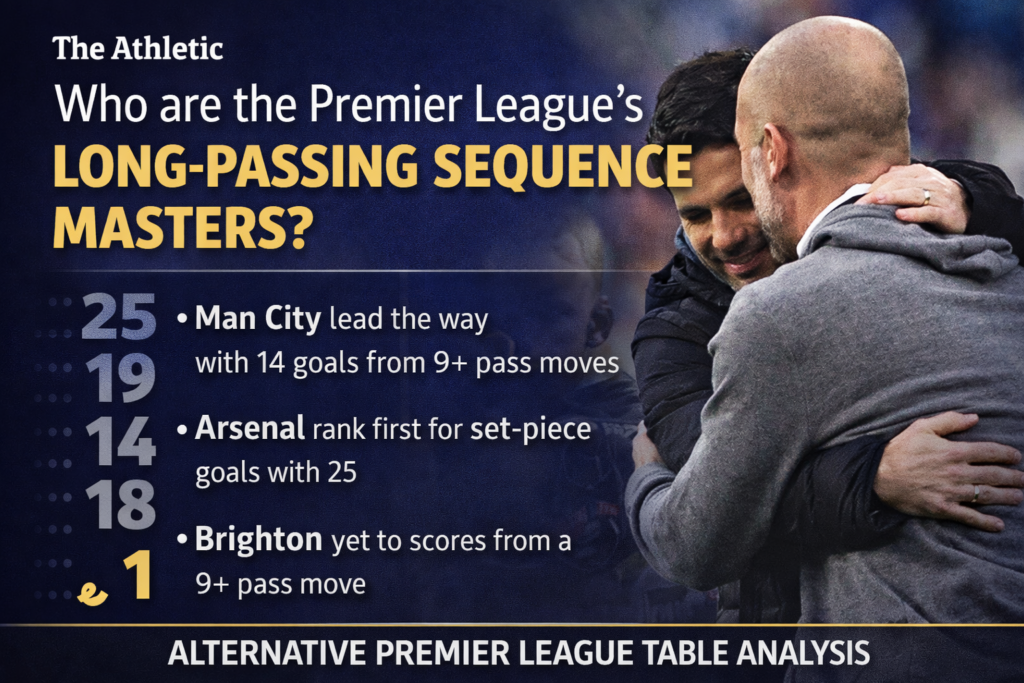
A new data analysis of the Premier League has revealed striking differences in how top-flight teams build attacks, with Manchester City continuing to set the standard for sustained passing moves, while Tottenham Hotspur rank bottom for structured build-up play.
The study examines goals scored from longer passing sequences, defined as moves involving nine or more passes, alongside shorter, more direct attacks and set-piece effectiveness.
Manchester City remain the benchmark for structured play
Pep Guardiola’s side once again lead the league for goals created from longer passing sequences, underlining their continued ability to combine control with speed.
City have already surpassed several of their recent seasonal totals for goals involving extended build-up play, despite still having fixtures remaining. One standout example included a flowing move involving multiple players and over a dozen passes, completed in under a minute.
While still dominant in possession, City’s overall style has subtly shifted. Their average number of passes per attacking sequence is lower than in previous peak seasons, suggesting a more direct edge to their traditionally patient approach. However, they remain among the fastest teams in terms of progressing the ball upfield.
Arsenal show balance but fewer long combinations
Arsenal’s attacking patterns highlight a different trend. While Mikel Arteta’s side remain strong in structured possession phases, the frequency of their longest passing sequences ending in goals has declined in recent seasons.
Their most effective moves often begin from deep positions, involving coordinated team movement and precise passing over several phases. However, analysts suggest these moments are becoming less common, with Arsenal increasingly prioritising control and territorial dominance over high-risk progression.
Despite this, Arsenal continue to excel in set-piece situations, remaining one of the most efficient teams in the league from dead-ball scenarios.
Brighton struggle to convert possession into key outcomes
Brighton’s data presents a surprising contrast. The team have produced a high volume of shots from longer passing sequences but are yet to convert any of these into goals this season.
Their ability to progress the ball through structured phases remains evident, but finishing efficiency has been lacking. They continue to generate chances through both controlled possession and mid-length passing combinations, yet final execution has not matched underlying performance levels.
Set-piece output has also dipped compared to previous seasons, contributing to a more uneven attacking profile.
Manchester United thrive in short, direct moments
Manchester United show one of the most extreme profiles in the league, with a large proportion of their goals coming from short sequences or rapid transitions.
Bruno Fernandes remains central to much of their attacking play, frequently involved in chance creation and quick progression into attacking areas. United’s most effective patterns often come not from sustained possession, but from immediate exploitation of defensive disorganisation.
Their reliance on shorter sequences is reflected in both open play and set-piece situations, where they remain among the league’s most productive sides.
Bournemouth and Brentford excel in direct football
Bournemouth stand out for their preference for fast, direct attacks, often involving fewer than five passes before a shot. While they do produce occasional longer passing moves, their primary threat comes from quick transitions and forward momentum.
Brentford follow a similar model, with a high proportion of their chances coming from rapid sequences starting deep in their own half. Their efficiency in these situations, combined with strong set-piece performance, underlines their structured but direct identity.
Liverpool and Spurs show notable decline in long sequences
Liverpool’s numbers indicate a reduction in goals created from extended passing moves compared to previous seasons. Opponents have increasingly disrupted their build-up patterns, limiting access to key midfield progression zones.
Tottenham, meanwhile, rank lowest in the league for shots and goals generated from longer passing sequences. The data reflects a clear shift toward a more direct style, compounded by injuries to key creative players. As a result, their ability to sustain attacks through multiple phases has significantly decreased.
Conclusion
The data highlights a Premier League increasingly divided between structured possession teams and direct transition sides. While Manchester City continue to lead in controlled build-up play, several teams have moved toward quicker, more vertical approaches.
Set pieces and transitional moments are proving just as important as sustained possession, with success increasingly defined by efficiency rather than style alone.
Source reference:
Based on analysis by Anantaajith Raghuraman, The Athletic, “Alternative Premier League Table – Long-passing sequences,” April 16, 2026.

