



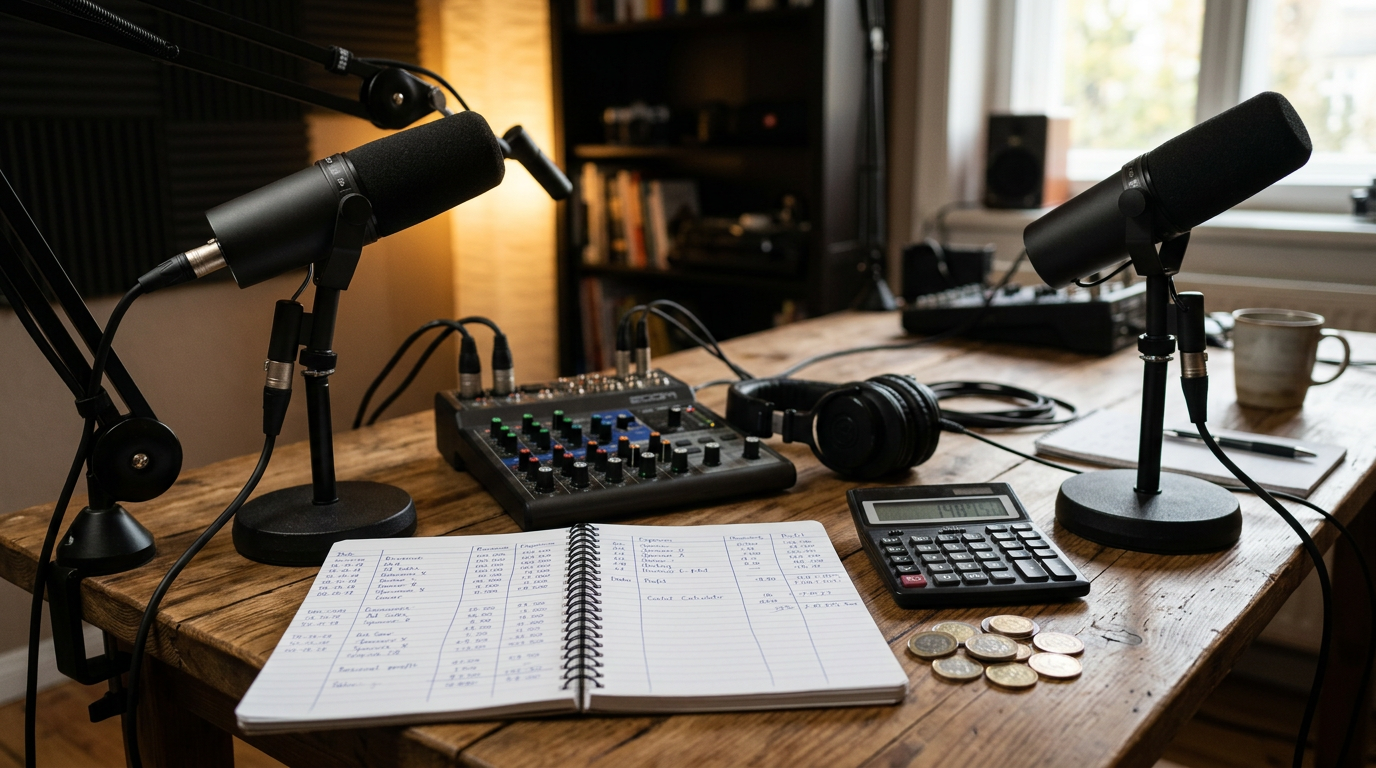

How do podcasts make money? Mainly through advertising and sponsorship, with a growing share coming from listener subscriptions, platform payouts for video, live shows, merchandise and branded content. In the UK, podcast advertising was worth £90 million in 2024, according to IAB UK. Big networks earn most of that money, but the same handful of models applies to a bedroom show with a few hundred listeners. This explainer sets out each model and what it really involves, as of October 2026.
How do podcasts make money from advertising?
Advertising remains the backbone of the business. IAB UK’s Digital Adspend study, produced with MediaSense, found that UK podcast ad spend grew 8% in 2024, slower than the 23% growth recorded in 2023. The scale of the listed companies tells the same story. Acast, the Stockholm-listed podcast platform, reports that most of its net sales are advertising revenue and that only about 4% comes from software and subscription products. In the second quarter of 2026 it posted net sales of SEK 775.6 million, up 28% year on year, and average revenue per listen or view of SEK 0.69, up 26%.
Podcast adverts come in three broad forms.
Host-read sponsorships
The presenter reads a message for a brand, often in their own words, and it is recorded into the episode. These “baked-in” reads stay in the file for as long as the episode exists, and they carry something of the presenter’s personal endorsement. They work best for shows with a loyal, clearly defined audience.
Dynamically inserted ads
Hosting platforms can slot adverts into marked breaks at the moment someone downloads or streams an episode. The same episode can therefore carry different ads for different listeners, by location or time, and older episodes keep earning. Acast highlights dynamic and targeted ad insertion as a core part of its offer to advertisers.
Programmatic and network deals
Smaller shows rarely deal with brands directly. Instead they join a hosting platform’s marketplace or a network, which bundles many podcasts together and sells the combined audience, often automatically. The podcaster receives a share of the revenue. It is the easiest route in, but the income per listener is usually modest.
Sponsorship can also be fickle. Podmerse, which launched a public database of podcast sponsorships on 28 October 2026, said that only 34% of the brand-and-show pairings it tracked in the first quarter of 2026 appeared again on the same show in the second quarter. As reported by PodcastingToday, its co-founder Anuj Agarwal said: “Most small and mid-size podcasters are struggling to monetise their shows.”
Subscriptions and memberships
The fastest-moving change in UK podcasting is paid membership. Listeners pay a monthly or annual fee for ad-free episodes, early access, bonus content or newsletters, while the free version stays available to everyone else.
- Global added six shows to its Plus subscriptions on 26 October 2026. Its release lists ad-free episodes from £2.99 a month or £29.99 a year, and ad-free episodes with exclusive content from £4.99 a month or £49.99 a year, on Global Player and YouTube.
- Sky News announced Sky News Insider: Podcasts in May 2026, for launch in June at £2.99 a month, bundling bonus episodes, ad-free listening, early access, a newsletter and first access to live-show tickets.
Subscriptions are attractive because they are steadier than advertising. Research published in October 2026 by Supporting Cast, a US subscription platform, found that members who activated their podcast feeds cancelled at an average of 1.3% a month, compared with 3% for members who never listened. The company was careful to say this does not prove that listening alone keeps people subscribed, since more committed fans may be more likely to listen in the first place.
Willingness to pay is real but limited. Ofcom research published in 2024 found that just over a third of regular UK podcast listeners would pay to subscribe to a favourite podcast, while 38% said they would not.

Platform payouts and video
Video has opened new income streams. Spotify’s Partner Program, launched in the UK, US, Canada and Australia on 2 January 2025, pays eligible creators based on how much Spotify Premium subscribers engage with their video episodes, and shares revenue from adverts played to free users. Creators keep all the money from sponsorships recorded into their episodes.
Audiences are following. Edison Research’s UK Podcast Consumer 2026 report found that 72% of UK weekly podcast consumers now watch video podcasts, and that YouTube has become the platform they use most. In May 2026, Acast ran its first video advertising campaigns inside Apple Podcasts’ new video feature. In August it paid $20 million for Backyard Ventures, a US creator network spanning audio, YouTube, newsletters and social media. Chief executive Greg Glenday said of the deal: “This is the future of podcast monetization, and we’re building it now.”
Live shows, merchandise and branded podcasts
Once a show has a loyal following, it can sell things directly to fans:
- Live events. Theatre tours and recorded live episodes turn listeners into ticket buyers; first access to live-show tickets is one of the perks in Sky News’s podcast subscription.
- Merchandise. Research by GWI published in October 2026 found that 40.9% of Millennials had bought, or would consider buying, podcast merchandise, compared with 33.4% of Gen Z and 22.5% of Gen X.
- Branded content. Companies commission production teams to make whole series for them. The work is now recognised in its own right: AudioUK’s 2026 Audio Production Awards include a dedicated Branded Content category.
- Donations and crowdfunding. Some independent shows ask listeners for direct support through membership platforms in return for extras.
Why BBC podcasts carry no adverts in the UK
The BBC is one of Britain’s biggest podcast producers but does not sell UK advertising around its licence-fee-funded podcasts. In its 2025/26 Annual Plan, published in March 2025, the corporation ruled out placing adverts around those programmes on third-party podcast platforms in the UK. The idea has resurfaced in the government’s BBC Charter Review Green Paper. In August 2026, 18 media organisations, including Global, Bauer, News UK and Radiocentre, wrote to Culture Secretary Lisa Nandy urging ministers to drop it. They cited Compass Lexecon analysis estimating that such advertising would raise between £5 million and £7.5 million a year, with a further £1 million to £2 million from the BBC Sounds archive. The signatories argue that extra BBC inventory would spread advertisers’ budgets more thinly and push down prices across the market. Ministers had not ruled the option out when the letter was sent.
What this means if you are starting out
For a new podcaster, income usually follows audience rather than the other way round. Most shows start by building a consistent release schedule and a clear niche, then test one or two revenue streams: a hosting platform’s ad marketplace, a small paid tier, or a single relevant sponsor. Keeping control of your RSS feed, tracking your statistics carefully and publishing a video version where it makes sense all strengthen your hand when brands or networks come calling. Choose sponsors with care, too: in regulated areas such as investing, UK authorities have already cracked down on influencers promoting financial products without authorisation. This article is general information, not financial advice.
Frequently asked questions
How much does a podcast earn per listen?
There is no fixed rate. As a guide to the economics, Acast reported average revenue of SEK 0.69 per listen or view across its network in the second quarter of 2026. That figure is the platform’s revenue, not what each creator receives, and it varies widely by audience and market.
How big is the UK podcast advertising market?
IAB UK put podcast ad spend at £90 million in 2024, up 8% on the year before.
Can UK podcasters get paid by Spotify?
Yes, eligible creators in the UK can join the Spotify Partner Program, which pays according to Premium video engagement and shares revenue from ads served to free users.
Are podcast subscriptions worth it for listeners?
That depends on how much you value ad-free listening and extras. UK offers seen in 2026 typically start at £2.99 a month, and free versions of the main shows remain available.
Sources: IAB UK via Podnews, IAB UK: podcast ad market grows 8% in the UK (29 April 2025); Radiocentre and others, Industry letter on BBC advertising on third-party platforms (6 August 2026); Acast, Interim report January–June 2026 (23 July 2026); Acast, Acast acquires Backyard Ventures (11 August 2026); Acast, First video advertising campaigns on Apple Podcasts (13 May 2026); Global, Global expands Plus offering with six new podcast subscriptions (26 October 2026); Sky News, Sky News Insider: Podcasts (18 May 2026); PodcastingToday, Podcasts could play a significant role in subscriber retention (27 October 2026); PodcastingToday, Podmerse launches podcast sponsorship database (28 October 2026); Ofcom, Top podcast listening trends from our research (30 September 2024); Spotify, The Spotify Partner Program is here (2 January 2025); Edison Research at SSRS, The UK Podcast Consumer 2026 (July 2026); PodcastingToday, Gen Z, Millennials and Gen X disagree on what counts as a podcast (24 October 2026); RadioToday, Commercial radio welcomes BBC scrapping proposals to introduce ads in podcasts (31 March 2025); LBB, UK Government urged to drop plans for advertising on BBC podcasts (7 August 2026).

