




If you are wondering how to start a podcast in the UK, you need five things: a clear idea of who the show is for, a decent microphone in a quiet room, software to record and edit, a podcast host that turns your episodes into an RSS feed, and listings on the big apps such as Apple Podcasts, Spotify and YouTube. The part that trips up most beginners is not the technology but the music. Using a commercial song usually needs permission from more than one rights owner, and the main UK licensing bodies do not offer a simple blanket licence for independent podcasters.
The audience is there if you can find it. Ofcom reported in July 2026 that 27% of UK adults now listen to a podcast every week, up from 7% a decade earlier, based on RAJAR figures. Edison Research’s UK Podcast Consumer 2026 report found that YouTube has overtaken Spotify as the platform weekly podcast consumers use most, which shapes how new shows should plan. This guide walks through each step, as of October 2026.
Step 1: Decide what your podcast is for
Before buying any equipment, write one sentence that describes the show and the listener it serves. “A weekly 30-minute conversation about running a small business in Wales” is far more useful than “a podcast about business”. A tight brief helps you choose a format, book guests and, later, explain the show to advertisers.
Common formats include:
- Solo or host-led shows, which are the easiest to schedule but rely heavily on the presenter’s voice and preparation.
- Co-hosted conversation, where chemistry between two or three regular voices carries the episode.
- Interview shows, which bring fresh material each week but need a steady pipeline of guests.
- Narrative or documentary series, which take the most research and editing but tend to stand out.
Decide on a realistic length and release schedule too. Listeners reward consistency, so a fortnightly show you can sustain beats a weekly one that stalls after six episodes. Check that your chosen name is not already used by a well-known podcast, and secure matching social media handles and a simple website if you can.
Step 2: Get the right kit without overspending
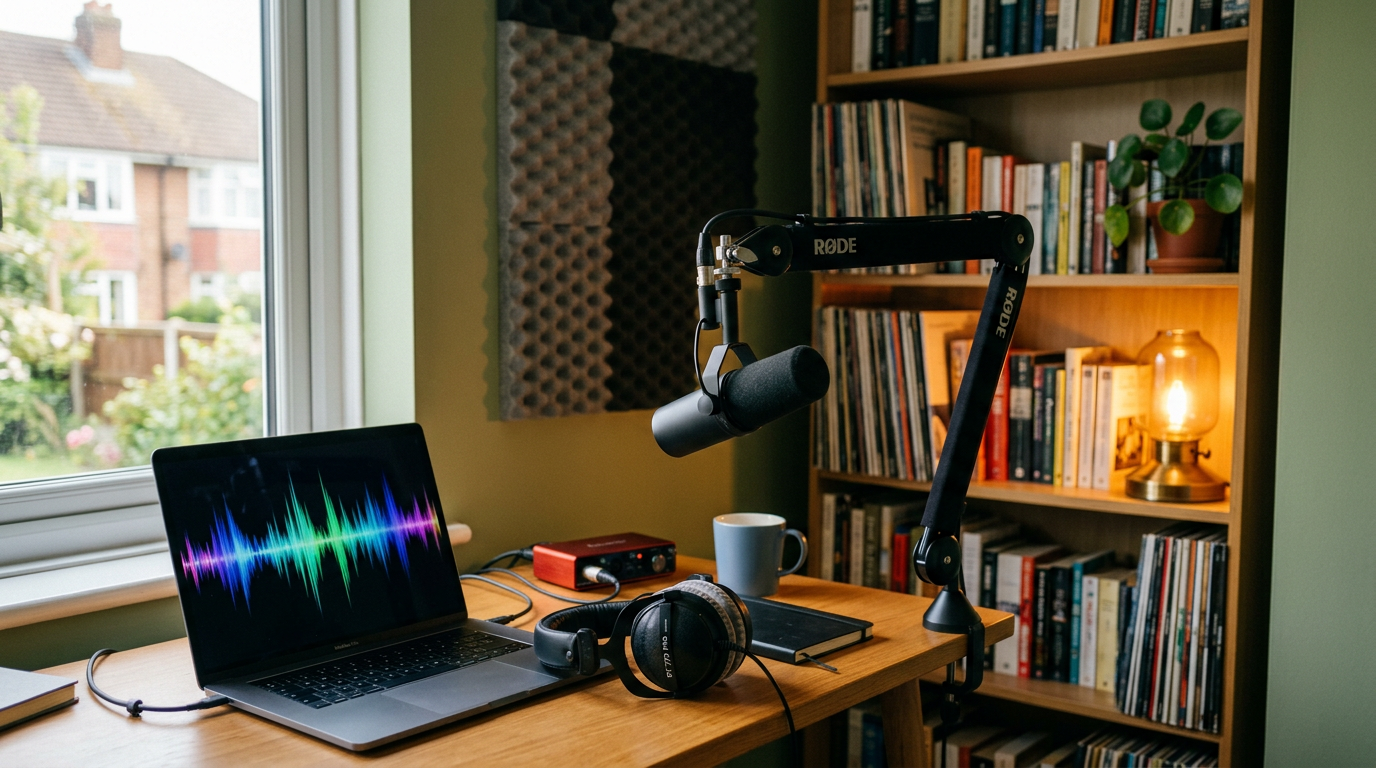
Good sound matters more than expensive gear. A modest microphone used close to the mouth in a soft-furnished room will usually sound better than a premium one in an echoey kitchen.
Microphones
Beginners generally choose between a USB microphone, which plugs straight into a laptop, and an XLR microphone, which needs a separate audio interface or mixer but offers more flexibility as the show grows. Dynamic microphones pick up less background noise than condenser models, which makes them a common choice for untreated home rooms.
Headphones and the room
Closed-back headphones let you hear problems such as hum or clipping as you record. Curtains, a rug, cushions and bookshelves all absorb reflections; many podcasters record in a bedroom or a wardrobe for exactly this reason.
Remote guests and video
For remote interviews, tools that record each participant’s audio locally and upload it afterwards avoid the dropouts of an ordinary video call. If you plan a video version, add a camera or a good webcam and some soft, even lighting. Edison found that 72% of UK weekly podcast consumers now watch video podcasts, up from 58% in 2023, so it is worth deciding early whether your show will be seen as well as heard.
Step 3: Record and edit with care
Free editors such as Audacity, or the editing tools built into many hosting and recording platforms, are enough to start. Aim for consistent volume between voices, trim long pauses and false starts, and remove distracting noise without over-processing the voices. Record a few test episodes that you never publish; they are the cheapest way to fix your microphone technique and pacing.
AI tools can now clean up audio, generate transcripts and suggest edits, but be careful about letting them speak for you. In Edison’s 2026 UK survey, 85% of weekly podcast consumers said they disapproved of AI hosting a podcast, even though most were comfortable with AI being used for research or brainstorming. The debate is not new: our report on the AI-recreated Michael Parkinson podcast shows how sensitive audiences are to synthetic voices.
Step 4: Choose a podcast host and create your RSS feed
Apps such as Apple Podcasts and Spotify do not store most independent shows themselves. Instead, you upload episodes to a podcast hosting service, which publishes an RSS feed: a constantly updated file listing your episodes, artwork and descriptions. The apps read that feed and show new episodes to listeners automatically.
When comparing hosts, look at:
- storage or upload limits and the price as your back catalogue grows;
- listener statistics and whether they follow industry measurement standards;
- support for video, transcripts and chapters;
- advertising and subscription tools if you hope to earn money later;
- how easily you can move your feed elsewhere, so you are never locked in.

Step 5: Get listed on Apple Podcasts, Spotify and YouTube
Once your feed exists, submit it to each directory. Apple asks for square show artwork, ideally 3,000 by 3,000 pixels; for RSS submissions it accepts sizes from 1,400 to 3,000 pixels square, in JPG or PNG, with no transparency. Apple also advises keeping the title legible at small sizes and warns that artwork using its own logos or hardware may be rejected.
On Spotify, the Spotify for Creators dashboard lets you either claim a show that already appears on the service or submit a new one using your RSS feed. Claiming unlocks analytics and features such as polls, comments, trailers and chapters. Spotify also lets creators set up a show directly on its own platform and upload audio or video there.
YouTube deserves serious thought. Edison’s 2026 report found that 29% of UK weekly podcast consumers use YouTube most often for podcasts, narrowly ahead of Spotify on 28%, with BBC Sounds on 15%. Even a simple static-image or webcam version can help a new show reach people who never open a dedicated podcast app.
Music in a UK podcast: the rights you need to know
A recorded song usually carries two separate copyrights. One covers the musical work (the composition and lyrics), managed for many songwriters and publishers by PRS for Music. The other covers the sound recording, usually owned by a record label and, for many broadcast and public uses, licensed through PPL. A podcast that uses a commercial track needs permission for both.
PPL’s own guidance, last updated in April 2026, says it does not license downloadable podcasts and that you need to contact the recording rightsholders directly, which in practice means approaching the label for each track. PRS for Music has developed a podcast and audiobook scheme aimed mainly at platforms. Its 2024 consultation response confirmed that the licence would sit with platforms and digital service providers, and the earlier 2023 consultation stated that it did not cover commercial sound recordings. PRS’s separate online licences also exclude sound recording rights. Because these terms are reviewed periodically, check PRS for Music’s current podcast licensing before relying on any scheme.
For most new podcasters the practical options are:
- commission an original theme from a composer and get the rights agreed in writing;
- use production or library music whose licence explicitly covers podcasts and online distribution;
- use royalty-free tracks only where the licence terms clearly allow commercial podcast use;
- avoid popular commercial songs unless you have cleared both the composition and the recording.
UK copyright law does allow “fair dealing” with a work for criticism, review, quotation and news reporting under section 30 of the Copyright, Designs and Patents Act 1988, provided the use is fair, no longer than needed and properly acknowledged. That can cover a short clip discussed in a music review show. It is not a general permission to use a song as theme music or a background bed.
How to start a podcast in the UK: a launch checklist
- A one-sentence description of the show and its audience.
- Three or more finished episodes ready, so new listeners can binge.
- Square artwork that meets Apple’s specifications and reads clearly at thumbnail size.
- A hosting account, a working RSS feed and listings on the main apps.
- Written permission or a suitable licence for every piece of music and every clip.
- Show notes, and ideally transcripts, for accessibility and search.
Frequently asked questions
Can I use a popular song in my podcast in the UK?
Only if you clear both the composition and the sound recording. PPL says it does not license downloadable podcasts, so you would normally need the record label’s permission as well as the publisher’s. Most independent shows use commissioned or properly licensed production music instead.
What size should podcast artwork be?
Apple Podcasts asks for square artwork, ideally 3,000 by 3,000 pixels, and accepts 1,400 to 3,000 pixels for RSS submissions, as a JPG or PNG without transparency.
Do I need to put my podcast on YouTube?
It is not required, but Edison’s 2026 research found YouTube is now the platform UK weekly podcast consumers use most, so a video or visual version can widen your reach considerably.
How often should a new podcast publish?
As often as you can sustain. A regular weekly or fortnightly slot helps listeners build a habit, and launching with several episodes gives newcomers more to sample.
Sources: Ofcom, Podcasts, pay TV and public service broadcasting: top trends (29 July 2026); Edison Research at SSRS, The UK Podcast Consumer 2026 (July 2026); Apple Podcasts for Creators, Show cover template (accessed October 2026); Spotify, Adding a new show to your Spotify for Creators account (accessed October 2026); PPL, Other online licences (updated 16 April 2026); PRS for Music, Podcast and Audiobook Consultation Response Summary (11 July 2024); PRS for Music, Podcast and Audiobook scheme consultation (10 May 2023); PRS for Music, Limited Online Music Licence Plus guide (2025 tariff); legislation.gov.uk, Copyright, Designs and Patents Act 1988, section 30.

