




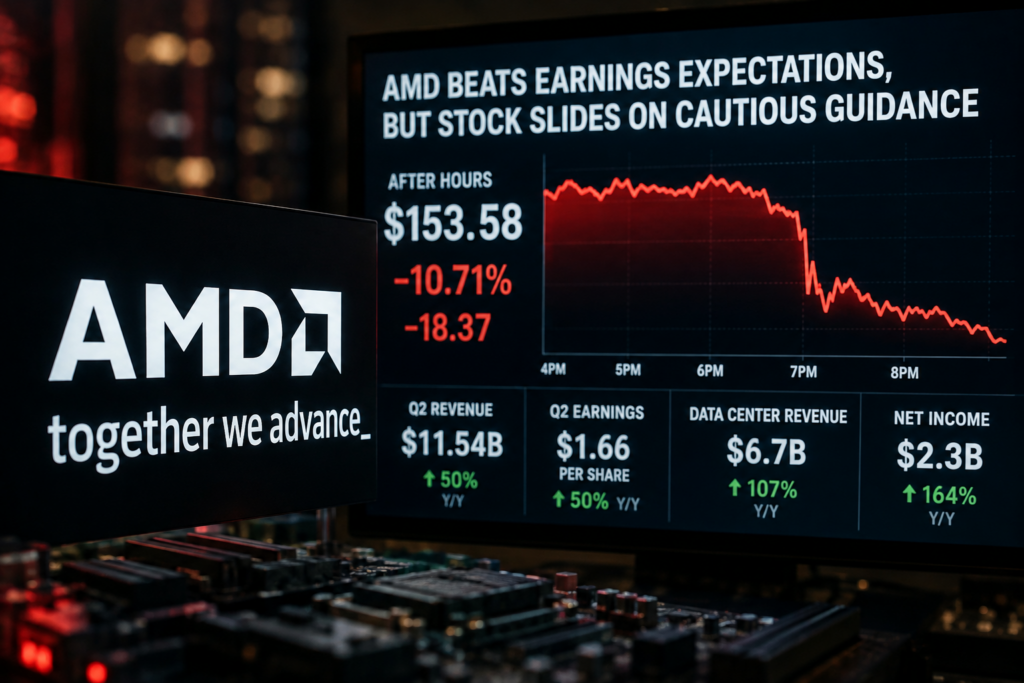
Advanced Micro Devices delivered a strong second-quarter earnings report on Tuesday, topping Wall Street estimates on both revenue and profit — yet shares fell more than 10% in extended trading, a reminder of just how high expectations have climbed for the chipmaker.
The Numbers
For the quarter ended June 27, AMD posted adjusted earnings of $1.66 per share against consensus estimates of $1.62, on revenue of $11.54 billion versus the $11.28 billion analysts had forecast. That represents a 50% jump in overall revenue compared with $7.69 billion a year earlier, underscoring how central AMD has become to the broader AI chip market.
Net income came in at $2.3 billion, or $1.38 per diluted share — a sharp rise from $872 million, or 54 cents per share, in the same period last year.
Data Center Business Leads the Charge
The clearest driver of AMD’s growth remains its Data Center division, where sales hit $6.7 billion, more than doubling year-over-year with growth of 107%. The company credited strength in both its CPU and GPU lines for the surge.
By contrast, AMD’s client and gaming segment — chips for laptops and consoles — grew a comparatively modest 6% to $3.8 billion, while its embedded chip business, aimed at industrial applications, rose 19% to $977 million.
Guidance Falls Short of the Most Bullish Forecasts
AMD guided for roughly $13 billion in revenue for the current quarter, plus or minus $300 million. While that figure topped the $12.52 billion analysts had penciled in, it fell short of the more optimistic estimates of up to $14 billion that some on Wall Street had been hoping for — likely a key factor behind the stock’s decline despite the earnings beat.
Looking further ahead, CEO Lisa Su told analysts on the earnings call that data center sales are expected to double in 2027, with server revenue climbing more than 80% year-over-year in the back half of fiscal 2026. She pointed to major cloud providers — including AWS, Microsoft, Google and Oracle — continuing to expand their use of AMD’s Epyc processors across both internal infrastructure and public cloud offerings.
Betting Big on AI Infrastructure
AMD’s ambitions extend beyond individual chips. This quarter, the company plans to begin shipping Helios, its first rack-scale AI system, to major customers including Meta, OpenAI and Oracle — a direct challenge to Nvidia’s complete AI system offerings rather than just its chips. AMD expects Helios shipments to gain momentum in the fourth quarter.
That expansion has come with a cost: capital expenditures jumped to $808 million for the quarter, up sharply from $282 million a year earlier and $389 million in the prior quarter, reflecting the scale of investment AMD is putting into its AI buildout.
The company has also grown increasingly bullish on the semiconductor market’s long-term trajectory, raising its projection in July for the industry’s total value to $2 trillion annually by 2028, with AI accelerators alone expected to account for $1.4 trillion of that figure — nearly triple its earlier estimate.
Word count: approx. 460

