




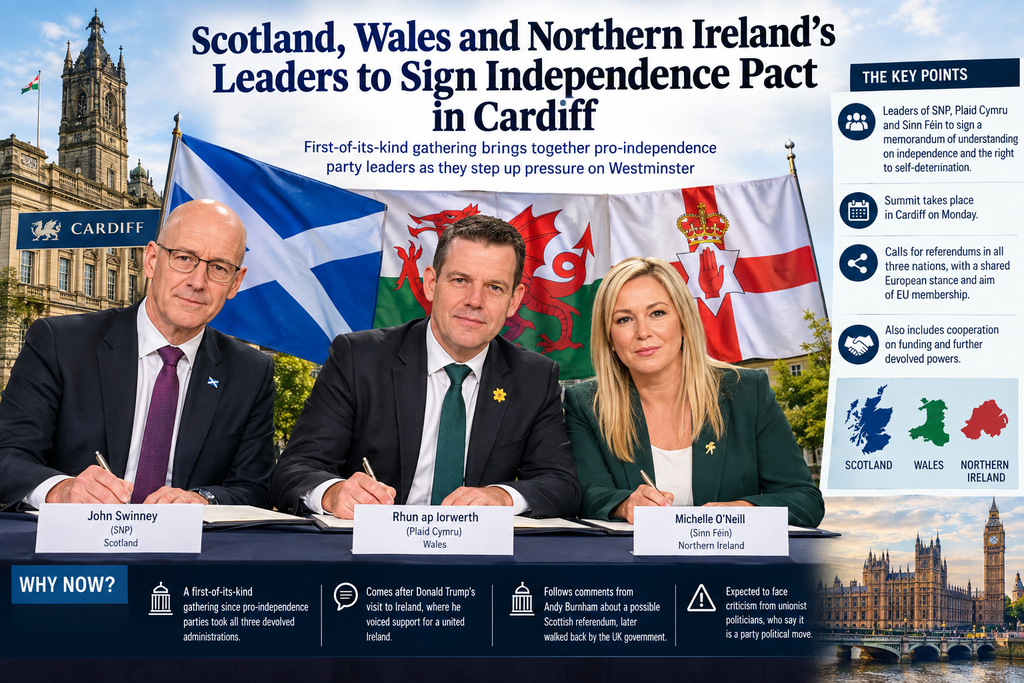
First-of-its-kind gathering brings together pro-independence party leaders as they step up pressure on Westminster
The leaders of Scotland’s, Wales’ and Northern Ireland’s pro-independence parties are set to meet in Cardiff on Monday to sign a joint agreement pushing for referendums on the future of the United Kingdom — a coordinated move that marks a significant escalation in the constitutional pressure facing Sir Keir Starmer’s government in Westminster, now led in day-to-day terms by Andy Burnham.
SNP leader John Swinney, Plaid Cymru leader Rhun ap Iorwerth and Sinn Féin vice-president Michelle O’Neill are expected to be the three signatories to a memorandum of understanding, alongside a broader declaration on the right to self-determination. Crucially, all three are attending as party leaders rather than in their formal roles as First Ministers of their respective governments — a distinction that has already sparked controversy in Belfast, where Stormont’s Deputy First Minister, Emma Little-Pengelly, has accused O’Neill of trying to use her official title to lend weight to a party political initiative she has no formal authority to pursue.
Why now
The summit is notable as the first gathering of its kind since pro-independence or pro-unity parties came to lead all three devolved administrations simultaneously. Plaid Cymru’s ap Iorwerth became Welsh First Minister after his party topped the polls in May’s Senedd election, the first time in the institution’s history it has been led by a party campaigning for Welsh independence. The SNP remains the largest party in Scotland despite recent losses at Holyrood, and Sinn Féin has led the Northern Ireland Executive since 2024.
Ahead of the talks, Swinney framed the moment as a broader constitutional turning point, arguing that Westminster’s current system is failing ordinary people and that a fresh start would only come through independence.
The timing has also been shaped by events beyond the UK’s borders: the summit follows a weekend visit to Ireland by US President Donald Trump, during which he voiced support for a united Ireland, adding further fuel to the debate just as the devolved leaders prepare to meet.
Mixed signals from Westminster
The gathering comes days after an apparent flashpoint in Westminster. Burnham told the House of Commons that a further Scottish independence referendum could be held if a “clear consensus” existed north of the border — remarks that briefly reopened a question successive UK governments have considered settled since Scotland’s 2014 referendum. A follow-up letter to Swinney reportedly walked that position back, reaffirming that a fresh vote remained off the table.
Despite that clarification, Scotland’s Education Secretary, Mairi McAllan, told the BBC’s Sunday programme that an independence referendum was still not off the table, suggesting the issue remains far from resolved within the Scottish government’s messaging.
What the agreement covers
According to reporting on the memorandum’s contents, the document is expected to go beyond a simple call for referendums. The three parties are reportedly set to align on a shared European stance, with an eventual aim of EU membership — Scotland and Wales potentially rejoining as independent states, and Northern Ireland via reunification with the Republic of Ireland. The declaration is also expected to touch on areas of practical cooperation between the devolved governments, including funding and further devolved powers, alongside the core constitutional demand.
A Sinn Féin source described the purpose of the summit as recognising that each of the nations has the democratic right to determine its own path, and argued that preparations for a possible referendum on Irish unity should begin in earnest now. Plaid Cymru’s ap Iorwerth, speaking separately on the BBC, said the three leaders shared common ground worth building on beyond the independence question itself, including calls for fairer funding settlements, while acknowledging differences between the three movements.
The reaction
The plans have drawn sharp criticism from unionist commentators and politicians, who argue the summit represents leaders overstepping their institutional roles to pursue a party political agenda, and that the constitutional integrity of the UK should not be treated as negotiable. Little-Pengelly’s intervention in Belfast reflects that wider unease, as does broader unionist commentary questioning whether Burnham’s government has been sufficiently firm in shutting down referendum speculation.
Those in favour of the memorandum counter that each nation has a democratic right to decide its own constitutional future, and that coordinated pressure from all three devolved administrations is a legitimate response to what they see as Westminster’s reluctance to engage seriously with the question.
Monday’s summit will be watched closely both for the precise wording of the memorandum and for how the UK government chooses to respond to a document signed by party leaders rather than heads of government — a distinction that may determine how much formal weight Westminster feels obliged to give it.
Compiled from reporting by the Press Association, The Telegraph, BBC News, The Irish News, Nation.Cymru and other outlets, September 2026.

